
Starburst is a NetEnt video slot released on 23 January 2012. It runs on a 5-reel, 3-row grid with 10 fixed paylines that pay both ways, left to right and right to left. Volatility is low, the maximum win is 500x your total bet (50,000 coins), and there is no scatter symbol and no traditional free spins round. The whole game turns on expanding, sticky Starburst Wilds that trigger up to three consecutive respins.
Starburst Slot Review for Australian Players: RTP Ranges, Volatility, Respins, Demo Play and the Fine Print
Provider
NetEnt
RTP
96.09%
Volatility
Low
Min bet
A$0.10
Max bet
A$100.00
Max win
500x (50,000 coins)

Table of ContentCloseOpen
- The short verdict
- Quick specifications: the verified Starburst specs sheet
- What this review covers
- What Starburst is and why it endures
- RTP, volatility and maximum win explained
- Starburst in the Australian context
- Starburst demo free and Starburst real money play: the practical decisions
- Fact-check: myths circulating in other Starburst reviews
- FAQ: Starburst questions Australian players ask
- Responsible gambling
- Appendix: data notes and verification method
- Last updated:12 February 2026
- Written and fact-checked by:the spin-fever-app.com iGaming research desk. Our analysts read provider game sheets, casino help files and Australian regulatory standards before publication.
- Edited by:Claire Bennett, senior casino content editor (editorial persona used for review standards and tone).

The short verdict
The single most important thing to check before you spin: Starburst ships with RTP ranges. Casinos can deploy either the 96.09% build or the reduced 94.05% build. On a $100 bankroll at $1 per spin, that difference costs you roughly 877 spins. Your money disappears about 40% faster in a game that looks identical.
Who it suits: players who want long, low-variance sessions, simple mechanics and small frequent wins. Who it does not suit: anyone chasing five-figure multipliers, bonus buys or big jackpot swings. There are none here. Not one.
Quick specifications: the verified Starburst specs sheet
Everything below is drawn from NetEnt's own game documentation and the in-game help files. Where competing review sites disagree with these figures, they are wrong. The fact-check table further down names the specific errors.
| Parameter | Value |
|---|---|
| Developer | NetEnt (release: 23 January 2012) |
| Reel grid | 5 reels, 3 rows (5x3 layout) |
| Paylines | 10 (fixed, Win Both Ways: pays left to right and right to left) |
| RTP range | 94.05% to 96.09% (depends on the casino's licensed configuration) |
| Volatility | Low |
| Min / max bet | A$0.10 / A$100 per spin |
| Bet structure | 10 lines × Level (1–10) × Coin Value (A$0.01–A$1.00) |
| Maximum win | 50,000 coins / 500x total bet |
| Bonus features | Expanding Starburst Wilds, Sticky Wilds, Respins (up to 3 in a row) |
| Scatter symbol | None |
| Free spins round | None (replaced by the Respin feature) |
| Multiplier symbols | None |
| Progressive jackpot | None |
| Bonus buy | Not available |
| Autoplay | Yes (up to 1,000 spins, with loss limits) |
| Mobile | Yes, HTML5 / NetEnt Touch, browser-based on iOS and Android |
| Theme | Cosmic, space, gems, retro arcade |
| Sequels | Starburst XXXtreme (2021), Starburst Galaxy (2024) |

What this review covers
- What Starburst is and why it endures
- Game features: paylines, symbols, expanding wilds and respins
- Full paytable for all seven symbols
- Betting range and how a spin is priced
- RTP, volatility and maximum win in regulatory and research terms
- Why RTP for Starburst can differ between casinos
- The maths of RTP ranges: how not to burn 40% of your deposit
- How to check the exact RTP in three steps
- Australian and New Zealand regulatory benchmarks
- Starburst within Australian gambling patterns
- Simulated gambling, demo modes and risk-taking
- Live streaming and slot visibility
- Practical implications: demo versus real money, bonuses, mobile
- Alternatives to Starburst
- Fact-check: myths circulating in other reviews
- FAQ
- Responsible gambling and help services
- Appendix: data notes and verification method
What Starburst is and why it endures
Starburst as a classic online slot
Starburst is a five-reel, ten-payline video slot developed by the Swedish supplier NetEnt and first released in January 2012. NetEnt describes it as an iconic title and «a staple in online casino portfolios worldwide», and the company has since built two direct successors on the same brand: Starburst XXXtreme (2021) and Starburst Galaxy (2024). That longevity is unusual. Most 2012-era slots vanished from lobbies years ago.
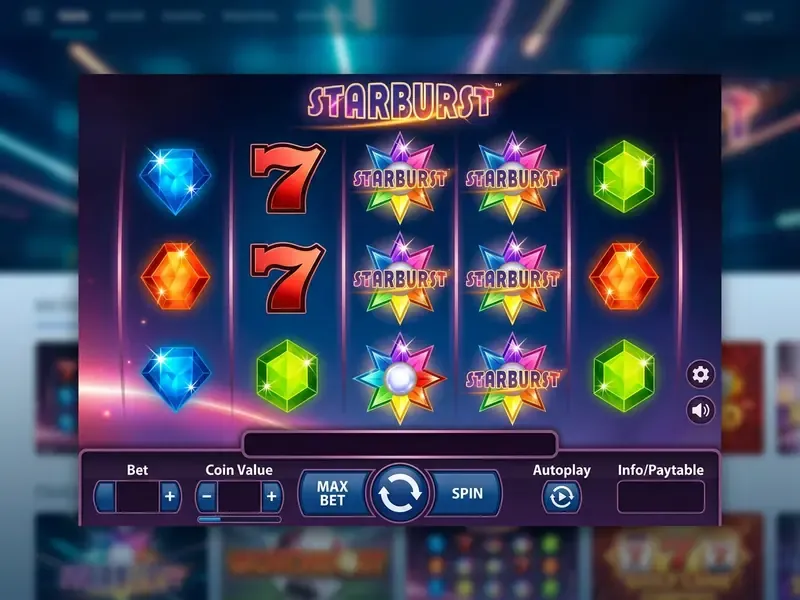
The design logic is deliberately minimal. There is no narrative, no cascading grid, no buy-in feature and no jackpot ladder. You get a dark cosmic backdrop, seven symbols (four coloured gems, a red gem, a Lucky 7 and a blue BAR) and a single special symbol, the multicoloured Starburst Wild. Spins resolve in about three seconds, wins arrive often, and losses arrive quietly.
That combination is precisely what «low volatility» means in practice: frequent, modest outcomes rather than long droughts punctuated by large hits.
Volatility is not a marketing term. It is a measurable property of a game's prize distribution. An NSW study of twenty gaming machine games examined how prize structure relates to player appeal and found that low-volatility games delivered smaller, more consistent prizes, whereas high-volatility games produced «higher value and more erratic prizes».
«Popular games tended towards moderate volatility; no direct correlation between volatility and popularity was found.» — NSW study of twenty gaming machine games
Hold on to that finding, because it undercuts a common review-site claim that Starburst is popular because it is low-volatility. The evidence suggests volatility alone does not drive popularity. Familiarity, availability across thousands of lobbies, its constant use in welcome-bonus free spin packages, and a very low cognitive load are more plausible explanations. In other words, the game is everywhere, so the game gets played.
On payout percentage, the top Starburst configuration sits marginally above the market midpoint. Global slot statistics show that the average RTP for online slots in 2023 was approximately 95.1%, with most games falling in a 94-96% band.
«The average online slot payout in 2023 was 95.1%, with most games sitting in the 94-96% range.» — Slot Statistics 2026, worldmetrics.org (2026)
Treat that benchmark as indicative rather than definitive. The underlying methodology is not fully transparent, and aggregate industry statistics of this kind mix jurisdictions, game types and reporting periods. The useful takeaway is directional: a 96.09% Starburst sits slightly above average, while a 94.05% Starburst sits at the bottom of the mainstream band.
Key game features of Starburst slot: paylines, symbols, expanding wilds and respins
Starburst runs 10 fixed paylines. «Fixed» means you cannot switch lines off; every spin plays all ten. What makes the line configuration unusual for a 2012 release is the Win Both Ways mechanic. A payline is evaluated from reel 1 to reel 5 and from reel 5 to reel 1. Land three matching gems on reels 3, 4 and 5 and you are paid, even though nothing landed on reels 1 and 2. In effect each of the ten lines is assessed twice, which is why a low-volatility game can still return a hit rate high enough to feel busy.
Wins require a minimum of three matching symbols on a line, and only the highest win per line is paid.
Lines do not stack multiple combinations. Two symbols can still pay if one of them is a Starburst Wild filling the gap.
There is no scatter symbol and no conventional free spins round. This is the single most frequently misreported fact about the game. Industry commentary suggests that the large majority of newer slot releases now ship with free spins or comparable bonus rounds. Figures around 80% circulate widely, though the sources behind that number do not publish a transparent methodology, so treat it as an industry impression rather than a verified statistic. Either way, Starburst is a deliberate outlier: NetEnt replaced the bonus round with a respin mechanic that lives inside the base game.
How wilds and repeat spins work, step by step
How the feature actually works
- Where it lands. The Starburst Wild appears only on reels 2, 3 and 4. It never lands on reel 1 or reel 5.
- Expansion. On landing, the Wild stretches to cover the entire reel, all three vertical positions.
- Sticky Wild plus respin. That reel locks in place while the remaining reels respin at no additional cost. Any win formed is paid.
- Chaining. If another Wild lands on an adjacent eligible reel during the respin, it also expands, also locks, and grants a further respin.
- The ceiling. The maximum is three consecutive respins. At that point reels 2, 3 and 4 are entirely covered by Wilds, which guarantees payouts across all ten lines in both directions. That is the configuration behind the game's largest outcomes.
Because Wilds substitute for every symbol, the three-Wild scenario resolves as ten winning lines built from whatever the highest-value symbols on reels 1 and 5 happen to be. This is the route to the 50,000-coin ceiling. It is also rare. The practical reality of low volatility is that most sessions never see a full three-reel lock, and plenty of players have logged hundreds of spins without one.
Full Starburst paytable
No competitor review we examined publishes a complete paytable. Here is the payout structure for all seven symbols, expressed as a multiple of coin value on a single line.
| Symbol | 3 of a kind | 4 of a kind | 5 of a kind |
|---|---|---|---|
| BAR (blue) | 50x | 200x | 250x |
| Lucky 7 | 25x | 60x | 120x |
| Yellow gem | 10x | 25x | 60x |
| Green gem | 8x | 20x | 50x |
| Red gem | 7x | 15x | 40x |
| Blue gem | 5x | 10x | 25x |
| Purple gem | 5x | 10x | 25x |
Two observations for players. First, the gap between the BAR and the gems is enormous: BAR pays 250x at five of a kind, more than four times the yellow gem. Second, the four lowest symbols are clustered so tightly (5x to 60x) that the vast majority of paid lines return less than the cost of the spin. That is the arithmetic behind the «frequent wins» impression. Many of those wins are partial refunds, not profit.
Betting range, paylines and winning combinations
Starburst does not use a single bet slider. Instead the cost of a spin is built from two controls:
10 paylines × Bet Level (1–10) × Coin Value (A$0.01–A$1.00) = A$0.10 to A$100 per spin
- Minimum:10 lines × Level 1 × A$0.01 = A$0.10
- Mid-range:10 lines × Level 5 × A$0.10 = A$5.00
- Maximum:10 lines × Level 10 × A$1.00 = A$100.00
Two practical notes. Because there is no progressive jackpot, there is no structural reason to play at max bet. Unlike jackpot slots, maximum stakes here unlock nothing at all. And because the 50,000-coin headline figure is denominated in coins, it is only reachable at the top bet configuration. At A$0.10 per spin, the 500x ceiling is A$50, not A$50,000.
Autoplay is available and supports up to 1,000 spins with configurable loss limits and stop-on-win conditions. Use the loss limit. It is the only built-in brake the game offers.
RTP, volatility and maximum win explained
Defining RTP, volatility and maximum win in regulatory and research terms
Loose definitions are the reason so many players misread these numbers, so it is worth borrowing the regulatory ones.
The Australian/New Zealand Gaming Machine National Standard defines return to player as the ratio of total wins to total turnover across a game cycle. It explicitly separates turnover from gamble bets and specifies that total wins are determined by the final gamble outcome.
«RTP is defined as the ratio of total wins to total turnover over a game cycle, including progressive and other features.» — Australian/New Zealand Gaming Machine National Standard
Three consequences follow. RTP is a long-run ratio across a full game cycle, not a promise about your session. It is calculated on turnover, meaning every dollar you re-stake from winnings counts again. And it is a theoretical figure derived from the game's mathematical model, verified by simulation rather than observed on your screen.
Volatility, in the same regulatory framework, is captured through standard deviation, and the standard imposes a hard limit on it.
«The standard requires that a game's NSD does not exceed 18; exceptions are permitted only where at least 2.5 million games are simulated.» — Australian/New Zealand Gaming Machine National Standard
That is a useful anchor. When a review calls Starburst «low volatility», it is describing a game whose normalised standard deviation sits at the very bottom of the permitted range: small dispersion around the expected value. It does not mean low risk. A low-volatility game with a 5.95% house edge still removes money at a predictable, relentless rate. It simply does so smoothly rather than in lurches.
Maximum win is the largest possible payout from a single spin or feature sequence, expressed either as a coin total (50,000) or as a multiple of stake (500x). For Starburst both figures describe the same event. Note the difference in scale versus modern releases: many current slots advertise ceilings of 5,000x to 50,000x. The 500x here is modest by design, and consistent with the game's low-variance mathematics.
| Parameter | What it measures | What it means for your play |
|---|---|---|
| RTP (94.05% or 96.09%) | Theoretical return across a full game cycle | Sets the house edge and, with it, how long a bankroll survives |
| Volatility (low) | Dispersion of outcomes around the expected value | Frequent small wins, few dry spells, rare large hits |
| Max win (500x / 50,000 coins) | Largest single outcome the maths allows | Caps the upside; no jackpot ladder above it |
Why RTP for Starburst can differ between casinos
Starburst is distributed with configurable RTP ranges. NetEnt's game documentation lists multiple RTP configurations for operators, so the same title, with the same graphics, sounds, paytable and respin logic, can run at different return percentages depending on which build the casino has deployed. The two versions you will meet in the wild are 96.09% and 94.05%.
Think of it the way you would think of blackjack rule variants. One venue pushes on a tied 18; another awards the tie to the dealer. The cards look identical and the dealing is identical, yet one table is measurably worse for you. In blackjack you can read the rule on the felt.
In a slot the entire difference is buried in the mathematical model behind the animation, which is exactly why so few players ever notice.
Whether operators actively prefer lower-RTP builds to widen their margin is not something we can demonstrate from published data. Operators do not disclose configuration decisions, and we found no source that quantifies deployment patterns. What is verifiable is that both builds exist, that they are not always disclosed prominently, and that the demo version almost always displays the highest advertised figure. Players who assume «Starburst is 96.09%» because that is the number every review repeats can be playing the 94.05% build with no on-screen signal whatsoever.
For context, these figures sit well above the floor that land-based standards permit. New Zealand requires non-casino gaming machines to return between 78% and 92%.
«In New Zealand, non-casino gaming machines must have an RTP between 78% and 92%; most machines are set at 91.5%.» — New Zealand gaming machine gambling statistics and information document
Online slots operate in a different competitive environment, but the comparison is instructive. Even the «bad» Starburst build returns more than a typical New Zealand pub machine. That is not a reason to accept it.
The maths of RTP ranges: how not to burn 40% of your deposit faster
The headline percentages understate the difference. What matters is the house edge, the share of every dollar staked that the operator keeps on average.
- At 96.09% RTP, the house edge is 100% − 96.09% = 3.91%
- At 94.05% RTP, the house edge is 100% − 94.05% = 5.95%
A 2.04-percentage-point drop in RTP produces a 52% increase in the house edge. Now translate that into playing time, with a A$100 deposit at A$1 per spin:
| 96.09% version | 94.05% version | |
|---|---|---|
| House edge | 3.91% | 5.95% |
| Expected spins from A$100 | A$100 / 0.0391 = 2,558 | A$100 / 0.0595 = 1,681 |
| At roughly 3 seconds per spin | about 2 hours 8 minutes | about 1 hour 24 minutes |
| Spins lost to configuration | n/a | −877 spins |
Your bankroll depletes roughly 40.5% faster on the low-RTP build, in a game that looks and feels completely identical. Forty-four minutes of entertainment, gone, with no visible difference on screen.
Two important caveats. First, these are expected values across a long run, not predictions for tonight; variance means your actual session could be far shorter or far longer. Second, the three-second-per-spin assumption is a convention for illustrating exposure. Autoplay is faster, manual play with breaks is slower, and speed of play is itself a risk factor because it determines how much turnover you generate per hour.
How to check the exact RTP in three steps
This takes under a minute, and it is the highest-value habit a slots player can develop.
- Log in and launch Starburst in real-money mode. Non-negotiable. Demo and not-logged-in sessions almost always display the base 96.09% figure regardless of what the operator has actually deployed for cash play.
- Open the in-game help. Tap the (?) or «i» icon, usually in the lower-left of the game screen or inside the burger menu.
- Scroll to the payout statement. Look for wording such as «The theoretical return to player for this game is...» or «The theoretical RTP of this game is...». If it reads 96.09%, you are on the good build. If it reads 94.05%, close the game and play somewhere else.
If the help file quotes several percentages, that usually reflects different feature configurations; take the base game figure as your reference. And if you cannot find any RTP statement at all, treat that as a transparency red flag when choosing an online casino. Reputable operators publish it.
You can cross-check the operator's figure against NetEnt's own product specification for the title. Where the two disagree, the discrepancy is normally explained by jurisdictional configuration, local regulation or a different game version. Even so, the number in the live real-money client is the one that governs your money.
Tasmanian RTP requirements and appendices to the national standard
Australian jurisdictions attach their own appendices to the national standard, and Tasmania's is a useful reference point for what «acceptable» looks like in a regulated land-based context. An earlier version set a minimum return of 85%, while a more recent July 2023 version increases the minimum to 87%.
«The Tasmanian appendix sets the minimum RTP at 87% under the July 2023 requirements, with no maximum specified.» — Tasmanian Appendix to the Australian/New Zealand Gaming Machine National Standard (July 2023)
The same appendix restricts a feature that has a direct online analogue:
«The Tasmanian appendix prohibits auto-gamble, the automatic doubling of stakes without manual player input.» — Tasmanian Appendix to the Australian/New Zealand Gaming Machine National Standard
Starburst has no gamble feature, so auto-gamble does not apply. But the regulatory intent, forcing a deliberate human action before stakes escalate, is worth importing into how you use Autoplay. Autoplay is not auto-gamble, yet it removes exactly the friction that regulators consider protective. If you use it, set the loss limit first.
New Zealand RTP and fairness requirements
New Zealand's framework adds explicit design-integrity rules that go beyond payout percentages. Machines must not manipulate or rearrange reel symbols, and must not create false impressions about the odds.
«Gaming machines must not create a false expectation of better odds for the player, and must not employ 'near-miss' design.» — New Zealand gaming machine gambling statistics and information document
Two things follow for Starburst players. Because the Wild lands only on reels 2, 3 and 4, players sometimes read a single non-expanding near-hit as «almost a feature». Under a compliant design, symbol positions are independently determined by the RNG and reel strips are not rearranged to manufacture that sensation. The perception of a near miss is a psychological artefact of reel-based presentation, not evidence of manipulation. And the prohibition on creating «a false expectation of better odds» is precisely the principle that undisclosed RTP ranges sit uncomfortably against.
RTP variation across casinos and the need for fact-checking
Put the benchmarks side by side and you get a practical yardstick:
| Benchmark | Figure |
|---|---|
| Starburst, high build | 96.09% |
| Global online slot average, 2023 | about 95.1% |
| Starburst, low build | 94.05% |
| Tasmanian land-based minimum (July 2023) | 87% |
| NZ non-casino machines (typical setting) | 91.5% |
| NZ non-casino permitted range | 78% to 92% |
Against this table, players can infer that a Starburst configuration with markedly lower RTP, say 90% or less, is less favourable than typical online standards and should be read as a serious warning about the operator generally. The same reasoning applies when choosing an online casino. An operator willing to deploy a degraded build of the most recognisable slot in the world is telling you something about its approach to every other game in the lobby.
Verification method matters as much as the number. Two primary sources are enough: NetEnt's official product specification for the title, and the help file and game rules of the specific licensed casino you are playing at. Anything else, including this review, is secondary.
Starburst in the Australian context
Positioning Starburst within Australian gambling patterns
Starburst is an online video slot, not a licensed Australian electronic gaming machine, and it is commonly accessed via online casino platforms rather than in a venue. That distinction matters legally and behaviourally, but it does not place the game outside the Australian evidence base, because the research on interactive gambling covers exactly this mode of play.
The Australian Gambling Research Centre at the Australian Institute of Family Studies surveyed 3,881 Australian adults between August and October 2024 using a probability-based mixed-mode design.
«65.1% of Australian adults participated in at least one form of gambling in the preceding twelve months.» — National Gambling Prevalence Study Pilot 2024, AGRC / Australian Institute of Family Studies (2025)
Participation on that scale means gambling is a mainstream activity, not a fringe one. The risk profile, however, is not evenly distributed, and it differs sharply by channel. A large peer-reviewed Australian study (n = 15,006) found that among interactive gamblers the problem gambling rate was 2.7% compared with 0.9% among non-interactive gamblers.
«Among interactive gamblers, the problem gambling rate was three times higher than among non-interactive gamblers: 2.7% versus 0.9%.» — Prevalence and determinants of problem gambling in Australia (n = 15,006), peer-reviewed journal
Online slot play sits squarely in the higher-risk category. That is not an argument that the format causes harm by itself. Availability, speed, 24-hour access, solitary play and frictionless deposits are all plausible contributors. Still, it is a reason to treat convenience as a cost rather than a feature.
Harm is also more common than headline «problem gambling» rates suggest. A national study of Australian adults using validated harm measures found that harm extends well beyond the clinically identified group.
«Approximately one in seven gamblers experiences at least one gambling-related harm, corresponding to roughly one in twelve Australian adults.» — Harm-to-self from gambling: a national study of Australian adults, peer-reviewed (2023-2024)
In that literature, the authors reported that EGMs had both the highest raw number of respondents identifying them as the most harmful form and a high harm rate relative to participation. Claims that electronic gaming machines account for «over half» of gambling problems in Australia are widely repeated. The published harm-attribution studies support EGMs, race betting and sports betting as the dominant contributors, but the precise share varies by methodology and harm instrument, so we present the ranking rather than a single percentage.
National prevalence of gambling and the central role of EGMs
The 2024 pilot study also broke participation down by jurisdiction, with Queensland reporting the highest prevalence at 70.2%, Western Australia at 69.6% and South Australia at 67.9%.
«Queensland recorded the highest gambling prevalence at 70.2%, while Victoria and Tasmania recorded the lowest at around 60%.» — National Gambling Prevalence Study Pilot 2024, AGRC (2025)
A ten-point spread between the highest and lowest jurisdictions is substantial, and it tracks differences in machine density, venue accessibility and state regulation. For an online player the state-level figure matters less than what it implies: gambling exposure in Australia is shaped heavily by how easy the product is to reach. Online slots collapse that distance to zero. No drive, no venue, no closing time.

Legality, access and choosing where to play
A frank note, because most reviews skirt it. Australia's Interactive Gambling Act restricts the supply of online casino games to Australian residents, and many providers therefore geo-restrict their content for Australian IP addresses. In practice this means:
- Availability varies. A given title may or may not load at a given operator from an Australian connection, and availability can change without notice.
- Demo play is the most reliably accessible mode. Free-play versions are widely available and carry no financial risk. Read the research on inflated demo modes below before treating that as harmless.
- Operator diligence is on you. Check the licence and regulator, published RTP information, complaint-handling and dispute channels, KYC and withdrawal terms, deposit-limit and self-exclusion tools, and whether payment methods and withdrawal timeframes are stated in writing.
- Legal position. The obligations under the Interactive Gambling Act fall primarily on operators rather than individual players, but your consumer protections when playing at an offshore site are materially weaker than in a domestically regulated market. If a dispute arises, you may have limited recourse.
This section describes general regulatory context and is not legal advice. Rules differ by state and territory and change over time; check the current position with the relevant regulator before acting.
Simulated gambling, youth exposure and normalisation of slot play
The Starburst free-play version is one of the most widely distributed demo slots on the internet. That makes the research on simulated gambling directly relevant here.
In work commissioned for the Victorian Responsible Gambling Foundation, practice modes are described as intended to promote gambling by presenting the activity in a risk-free environment.
«Practice modes frequently use inflated or greater-than-100% payout rates, presenting gambling in a risk-free environment.» — Daniel King, Online gaming and gambling in children and adolescents: Normalising gambling in cyber places, Victorian Responsible Gambling Foundation (2018)
Note the mechanism. It is not merely that demo play is free, but that the demo can be mathematically more generous than the paid product. A player who forms expectations in the free version and then transfers them to cash play is calibrated to the wrong game.
The scope of simulated gambling extends well past casino demos. NSW research maps the full landscape.
«The NSW study identifies six forms of simulated gambling among young people, including demo games, simulated gambling apps and loot boxes.» — NSW Youth Gambling Study 2020, Office of Responsible Gambling NSW
Young people meet these formats through social casino apps, gambling-themed mini-games and in-game purchase mechanics, often without clear awareness that they mimic gambling mechanisms. For adolescents and young adults navigating iGaming platforms for the first time, free-play offerings can be particularly appealing: no age verification friction, no deposit, and familiar visual language borrowed from mobile gaming.
Experimental evidence on inflated practice modes and risk-taking
The link between demo exposure and later real-money behaviour has been tested experimentally rather than merely asserted. In a peer-reviewed study, participants (n = 128) were assigned to free-play conditions with different payout settings and then moved to a real-money-equivalent task, where their betting behaviour and persistence were measured.
«Participants exposed to an inflated demo mode placed significantly larger bets in real play compared with the control group.» — Exposure to Free-Play Modes in Simulated Online Gaming, peer-reviewed journal (c. 2014)

This is the finding that should change how you use the Starburst demo. Free play is genuinely useful for learning the interface, watching how Wild expansion and respins resolve, and getting a feel for hit frequency. It is not a reliable guide to how much you should stake, how often you will win, or how long a bankroll lasts. And the experimental evidence indicates that the mismatch does not stay theoretical. It shows up in your bet size.
Two safeguards follow. Decide your stake level before opening the demo, in dollars you are prepared to lose, and do not revise it upward on the basis of demo results. And wherever possible, verify the demo's stated RTP against the real-money client using the three-step check above. If they differ, you have direct evidence of a calibration gap.
Live streaming of gambling and the visibility of Starburst
Slot content has migrated onto streaming platforms, adding a channel of exposure that did not exist when Starburst launched. Australian research has begun mapping it: a 2024 project explores who watches gambling live streams, why they do so, and what effects live streaming has on gambling behaviour.
«A 2024 study examines the audience for gambling live streams, viewing motivations and the behavioural effects on players.» — Live Streaming Gambling: Who watches, why, and what effects is it having?, NSW Responsible Gambling Fund / University of Sydney (2024)

We could not verify claims, common on review sites, that Starburst specifically is a streaming staple. No source we examined quantifies title-level streaming frequency. What can be said more carefully is that visually distinctive, easy-to-explain, high-volume slots are structurally well suited to streaming formats, and Starburst fits that description. Two associated risks are worth naming regardless of the title on screen. Streams display outcomes selectively, over-representing large wins relative to their true frequency. And bonus-buy content, which does not exist in Starburst, is heavily represented in the genre, potentially shaping expectations the game cannot meet.
Starburst demo free and Starburst real money play: the practical decisions
Disclaimer: This information is general in nature and does not substitute for professional advice. Gambling carries a risk of financial loss. If you are having difficulty controlling your gambling, seek professional help. Contact details appear at the end of this article.
When to choose Starburst demo and when to play for real money
Use the demo to: learn the control layout (spin, bet level, coin value, paytable, autoplay), watch the Wild land on reels 2 to 4 and expand, see a respin chain resolve, and confirm that there is no scatter, no free spins round and no bonus buy. Twenty minutes is plenty.
Do not use the demo to: calibrate stakes, estimate session length, judge how «hot» the game runs, or test a betting system. Demo experiences can influence bet sizes in later real-money play, even when players know they are switching to a different payout environment.
«Participants who played a demo with inflated RTP placed significantly larger bets when transitioning to real money.» — Exposure to Free-Play Modes in Simulated Online Gaming, peer-reviewed journal (c. 2014)
Before your first real-money spin, work through this checklist:
- Verified the operator's licence and regulator
- Read the in-game RTP statement in real-money mode: 96.09%, not 94.05%
- Set a deposit limit in account settings
- Set a session time limit
- Chosen a stake you can lose without consequence (on a A$100 bankroll, A$0.10 to A$0.50 per spin gives meaningfully longer play than A$1)
- Configured an Autoplay loss limit, if using Autoplay
- Confirmed withdrawal terms, KYC requirements and processing times
Starburst bonus buy and casino bonuses: what actually applies
There is no bonus buy in Starburst. The game predates the feature entirely, and NetEnt has never retrofitted it. Any site advertising a «Starburst bonus buy demo» is either mislabelling a different title or misleading you outright.
What does exist in abundance is Starburst as the designated game in free-spin promotions. It is arguably the most heavily bonus-bundled slot in the industry, which is exactly why players need to read the conditions attached to those offers.
Disclaimer: Bonus information is provided for general guidance only. Bonus terms vary by casino and jurisdiction. Verify the current rules directly on the operator's site before accepting any offer.
Typical terms attached to Starburst free spins and welcome packages, and always confirm the actual figures in the operator's bonus policy:
| Condition | What you commonly see | Why it matters |
|---|---|---|
| Wagering requirement | 30x to 50x | Above 30x, the practical value of the offer falls sharply |
| Wagering basis | Bonus only, or bonus plus deposit | «Bonus plus deposit» effectively doubles the requirement |
| Slot contribution | 100% for Starburst | Slots usually count fully; table games often 10% or 0% |
| Max bet while bonus active | Often around A$5 | Exceeding it can void the entire bonus and any winnings |
| Max cashout on no-deposit spins | Frequently capped | A «100 free spins» offer can be worth a fixed small ceiling |
| Expiry | Often 7 days | Short windows push you into higher-volume play |
| Spin value | Frequently A$0.10 | 100 spins at A$0.10 is A$10 of turnover, not A$100 |
| Game restriction | Starburst only | You cannot move the spins to a higher-RTP title |
Three rules of thumb. If the wagering requirement exceeds 30x, seriously consider declining the offer. If the terms require you to wager deposit and bonus together, treat the headline number as roughly half its stated value. And be sceptical of «wager-free» marketing: it usually arrives with a withdrawal cap that makes the real value far smaller than advertised. As a general principle, the more generous an offer looks, the more carefully you should read it.
There is an added wrinkle specific to this game. Free spins are credited on the operator's deployed build. If that build runs at 94.05%, your bonus turnover is being processed at a 5.95% house edge, which materially reduces the expected value of the promotion. Run the three-step RTP check before you accept Starburst spins, not after.

Starburst mobile (NetEnt Touch): browsers, apps and one warning
Starburst mobile runs on HTML5 through NetEnt Touch, so the online slot plays directly in a mobile browser on iOS and Android without any download. Layout, paytable, RTP configuration and the respin mechanic are identical to desktop. Only the control placement changes, with the bet panel collapsing into a compact menu on smaller screens.
There is no official standalone Starburst app. Any app store listing promising «Starburst, real money» outside a licensed operator's own casino app should be treated as suspect. Reported risks around unofficial gambling apps include malware, credential harvesting and payment-detail theft. Play Starburst either through your licensed operator's official app or through its mobile site in your browser.
Practical mobile notes: performance is undemanding and the game runs well on older hardware; a dropped connection mid-spin is resolved server-side, with the outcome credited when the session resumes; and battery-saver modes can throttle animation without affecting the result, since outcomes are determined by the RNG before the reels visibly stop.

Bankroll management and who this slot is not for
Low volatility changes the shape of your losses, not their existence. Three specific traps:
- The frequent-win illusion. Many paid lines return less than the spin cost. A «win» of A$0.30 on a A$1.00 spin is a 70% loss dressed as a win, a phenomenon researchers call losses disguised as wins.
- Stake escalation. Because losses feel gentle, players often raise stakes to make the wins feel meaningful. Doing so multiplies the hourly loss rate without altering the house edge.
- Speed. A three-second spin cycle on Autoplay produces roughly 1,200 spins an hour. At A$1 per spin on the 94.05% build, that is around A$71 of expected loss per hour.
Starburst is not for you if you want maximum wins above 500x, bonus buys, progressive jackpots, free spins rounds, multipliers, or high-variance sessions with the possibility of a life-changing hit. None of those exist in this game, and no strategy can create them. It is also a poor fit if long, uneventful sessions tempt you into raising stakes.
Alternatives to Starburst
If the title is unavailable at your operator, or you want a comparable feel with different mathematics, these are the closest relatives. In every case, run the three-step RTP check before playing. RTP ranges apply across the industry, not just to Starburst.
| Game | Provider | How it compares to Starburst |
|---|---|---|
| Starburst XXXtreme (2021) | NetEnt | Direct sequel. Same visual language, dramatically higher volatility, added Wild multipliers and a far larger maximum win. Not a like-for-like substitute; the risk profile is fundamentally different. |
| Starburst Galaxy (2024) | NetEnt | Newer instalment on the same brand, expanded feature set. Availability is thinner than the original. |
| Berryburst | NetEnt | Cluster-pays reinterpretation of the Starburst formula with expanding Wilds; comparable low-key feel, different win-evaluation logic. |
| Space Wars | NetEnt | Cosmic theme, both-ways-style evaluation, similarly simple structure. |
| Crystal Sun | Play'n GO | Gem-based, clean presentation, comparable simplicity from a different studio. |
Rather than quoting RTP figures for these titles, we deliberately point you to the in-game info screen. Published averages are frequently out of date, and operator-level configuration is what actually governs your money.
Fact-check: myths circulating in other Starburst reviews
We compared four widely ranking Starburst reviews against provider documentation. One contained systematic errors. Here is what to disregard.
| Claim seen in the wild | Status | Correct position |
|---|---|---|
| «5 reels, 5 rows» | False | The grid is 5 reels by 3 rows (5x3 layout). |
| «4,000x jackpot» | False | Maximum win is 500x total bet / 50,000 coins. |
| «5,000x winning on a single spin» | False | Same as above; 500x is the ceiling. |
| «Wild symbol: No» | False and self-contradictory | The Starburst Wild is the game's central mechanic. |
| «Autoplay option: No» | False | Autoplay is available, up to 1,000 spins. |
| «Free spins: search for lucky Star free spins» | Misleading | There are no free spins. The feature is a respin chain, maximum three consecutive. |
| «Medium volatility» | Contested | Predominantly documented as low; some vendor materials describe it as low-to-medium. See appendix. |
| «Unlimited cheats in the demo version» | False | There are no cheats. Outcomes are RNG-determined; demo play cannot be manipulated. |
| «Jackpot: $92,143.15» | False | There is no progressive jackpot in Starburst. |
| «Maximum winnings 50,000 coins» | Correct | Accurate at the maximum bet configuration. |
| «Min RTP 94.05%, max RTP 96.09%» | Correct | These are the two official NetEnt builds. |
FAQ: Starburst questions Australian players ask
It is a legitimate NetEnt title used by thousands of licensed operators, with outcomes determined by a certified random number generator. The genuine issue is not rigging but configuration: the same certified game exists in a 96.09% and a 94.05% build, and operators are not always transparent about which one they have deployed. Check the help file in real-money mode.
No. There is no free spins round and no scatter symbol. What people call «free spins» in Starburst is the respin feature: an expanding Wild locks its reel and the other reels spin again at no cost, up to three consecutive times.
50,000 coins, equal to 500x your total bet. At A$100 per spin that is A$50,000; at A$0.10 per spin it is A$50. Claims of 4,000x or 5,000x are false.
Either 96.09% or 94.05%, depending on the operator's build. Never assume the higher figure. Verify it in the in-game help while logged in and playing for real money.
Demo play is broadly accessible. Real-money availability depends on operator geo-restrictions and licensing, and it can change without notice. Verify the operator's licence, terms and dispute channels before depositing, and understand that consumer protections at offshore sites are weaker than in a domestically regulated market.
No official standalone app exists. The game runs in-browser via HTML5 on iOS and Android, and inside licensed operators' own casino apps. Treat third-party «Starburst» apps as a security risk.
No. The feature has never been added to this title. Any «Starburst bonus buy» offer is mislabelled.
Sometimes. Check the wagering multiplier, whether the deposit must be wagered alongside the bonus, the max bet while the bonus is active, the withdrawal cap, the per-spin value and the expiry window. Then check which RTP build the spins will run on.
Often not. Demo and not-logged-in sessions typically display the highest advertised RTP regardless of the operator's live configuration. Research on practice modes also documents payout settings that are inflated relative to the paid product.
No. There is no progressive jackpot and no feature gated behind stake size, so maximum bet unlocks nothing. It simply increases turnover, and therefore expected loss per hour.
That is a function of the casino, not the game. Withdrawal speed depends on the operator's payment methods, KYC processing and internal review times, all of which should be stated in its terms.
None can change the house edge; it is fixed by the game's mathematics. The only variables you control are which RTP build you play, your stake size, your session length and your speed of play. Those four levers determine how long your bankroll lasts. Nothing else does.
Responsible gambling
Slots are designed as entertainment with a built-in mathematical advantage to the operator. Over any meaningful volume of play, the expected outcome is a loss. Low volatility does not change that; it only makes the loss feel smoother.
Practical safeguards:
- Set deposit, loss and session limits in your account before you play, not during a session.
- Never gamble with money allocated to rent, bills, food or debt repayment.
- Do not chase losses by increasing stakes; the house edge is unchanged by bet size.
- Take scheduled breaks, treat Autoplay with caution, and always attach a loss limit.
- Use self-exclusion if you find yourself unable to stop.
Australian support services:
- Gambling Help Online, 1800 858 858, free, confidential, 24/7 counselling and online chat.
- BetStop, Australia's National Self-Exclusion Register, which lets you block yourself from licensed interactive wagering services.
- Lifeline, 13 11 14, for crisis support.
Gambling is restricted to adults aged 18 and over. This article is general information, not financial, legal or medical advice.
Appendix: data notes and verification method
How we verified the specifications. Every figure in the specs sheet and paytable was checked against two categories of primary source: NetEnt's own product documentation for the title, and the in-game help and rules text as presented in live client builds. Where a competitor claim conflicted with both, we classified it as false and listed it in the fact-check table rather than silently omitting it.
Note on volatility classification. The overwhelming majority of documentation and in-client descriptions classify Starburst as low volatility, and its behaviour (high hit frequency, small average win size, 500x ceiling) is consistent with that. Some vendor-adjacent materials have described it as «medium» or «low to medium». We report low because it aligns with the observable prize distribution and with the standard-deviation framing used in the Australian/New Zealand Gaming Machine National Standard, but we flag the discrepancy rather than conceal it.
Note on layout. Some third-party listings, and even a few vendor-adjacent sheets, have described a «5-row» configuration. The playable grid presents three visible rows across five reels, which is why a Starburst Wild expanding to «cover the whole reel» occupies three positions rather than five. Reviews reporting a 5x5 grid are describing something that does not match the game on screen.
Note on release date. NetEnt lists 23 January 2012 as the release date. Some casino databases display 2013 dates, which generally reflect the NetEnt Touch mobile release or a regional rollout rather than the original launch.
Note on evidence quality. Where a claim rests on aggregate industry statistics without published methodology, such as market-average RTP figures or estimates of how many new slots include free spins, we have flagged it as indicative. Where a claim rests on government research, regulatory standards or peer-reviewed studies, we have cited the publication and year. Claims we could not substantiate from either category, including title-level streaming popularity and operator motivations for selecting lower-RTP builds, have been reframed as reasoning rather than presented as fact.
Corrections and updates. Bonus terms, operator availability and deployed RTP configurations change frequently. If you find a figure on this page that no longer matches what you see in a live client, tell us. We will re-verify, update the page, and change the revision date at the top.