
Spin Fever
Roulette Online Rules, Demo Play, Live

Roulette Online: Rules, Demo Play, Live Dealer Casinos and How to Choose a Safe Site

Last reviewed: February 2026 · Editorial review: Claire Bennett, Senior iGaming Content Editor (compliance, bonus terms and payment auditing) · Audience: Australian residents aged 18+

Online roulette is a classic casino game where players predict where a small ball will land on a spinning, numbered wheel. Simple premise. Slightly less simple in practice, because understanding roulette online properly means looking at the rules, the betting mechanics, the odds and the platform itself before you stake a single dollar.


Table of ContentCloseOpen

"Before looking at welcome bonuses or headline offers on any casino platform, players must inspect table limits, game eligibility and withdrawal rules. A transparent review evaluates compliance, software mechanics and risk controls before presenting promotional benefits." (Claire Bennett, Senior iGaming Content Editor)

Key Takeaways in 60 Seconds

Key Takeaways in 60 Seconds

  • The wheel decides everything. European and French wheels hold 37 pockets (single zero); American wheels hold 38 (0 and 00). House edge: 2.70% against 5.26%.
  • French roulette is mathematically the friendliest standard variant: La Partage and En Prison halve the edge on even-money bets to roughly 1.35%.
  • Payout ratios never change between variants. Only your winning probability does, which is why single-zero tables are always the better structural choice.
  • Inside bets (35:1 down to 5:1) deliver high variance; outside bets (2:1 and 1:1) deliver frequent, smaller returns.
  • Roulette demo play uses the same RTP maths but zero financial risk. Real money play adds KYC verification, bonus eligibility and psychological pressure.
  • Live dealer roulette streams a physical wheel; OCR cameras plus a game logic server cross-check every result before payouts are credited.
  • Roulette usually contributes only 0 to 10% toward bonus wagering. For roulette-only players, most welcome bonuses are effectively unclearable.
  • Australian legal context: the Interactive Gambling Act 2001 restricts unlicensed online casino services, and the 2023 amendments ban credit cards and digital currencies for regulated interactive wagering.
  • No strategy beats the maths. Martingale, Fibonacci and flat betting change variance, never expected value.
  • Support is free and confidential: National Gambling Helpline 1800 858 858; self-exclusion via BetStop.

Roulette Variants at a Glance

Before the detail, here is the shape of the decision. This single table answers the question most readers actually arrive with: which roulette game should I sit at?

VariantPocketsHouse edge (standard bets)Distinguishing featureBest suited to
European roulette37 (single zero)2.70%Widest availability online and in live studiosMost players, as the default choice
French roulette37 (single zero)2.70%, or about 1.35% on even-money betsLa Partage and En Prison zero rulesEven-money bettors chasing the lowest edge
American roulette38 (0 and 00)5.26%Extra double-zero pocket, same payoutsNobody, on maths alone
Mini roulette13 (0 to 12)Varies by vendorHalf stake returned on zero for even-money betsSmall-stake, short-session play
Multi-ball roulette37Varies by ball countUp to 10 balls, no two in one pocketPlayers comfortable with scaled stakes
Multi-wheel roulette37 per wheel2.70% per wheelUp to eight wheels spun at onceExperienced players watching turnover

One caveat worth repeating: the edge figures above assume the published paytable is standard. Vendor variants often are not.

What Roulette Is and How the

What Roulette Is and How the Game Works

Roulette is a game of chance where players wager on the outcome of a ball dropped into a rotating wheel containing 37 or 38 numbered pockets. A standard roulette game consists of a physical or digital roulette wheel, a marked betting table layout, a dealer or automated game engine, and betting chips representing various monetary denominations.

In digital iGaming environments, roulette is delivered either through Random Number Generator (RNG) software or through live studio video streams. In Australia, interactive casino gambling is strictly governed by the Interactive Gambling Act 2001 (IGA), under which the Australian Communications and Media Authority (ACMA) actively investigates and blocks unlicensed offshore casino services offering games such as roulette, slots and poker.

"Between January and March 2023, the ACMA completed 15 investigations into 21 services and identified 20 breaches of the Interactive Gambling Act." (ACMA Enforcement Report, January to March 2023). https://www.acma.gov.au

Each spin of the roulette wheel functions as an independent probabilistic event. Previous outcomes carry no mathematical influence over future results, no matter how convincing the pattern on the scoreboard looks.

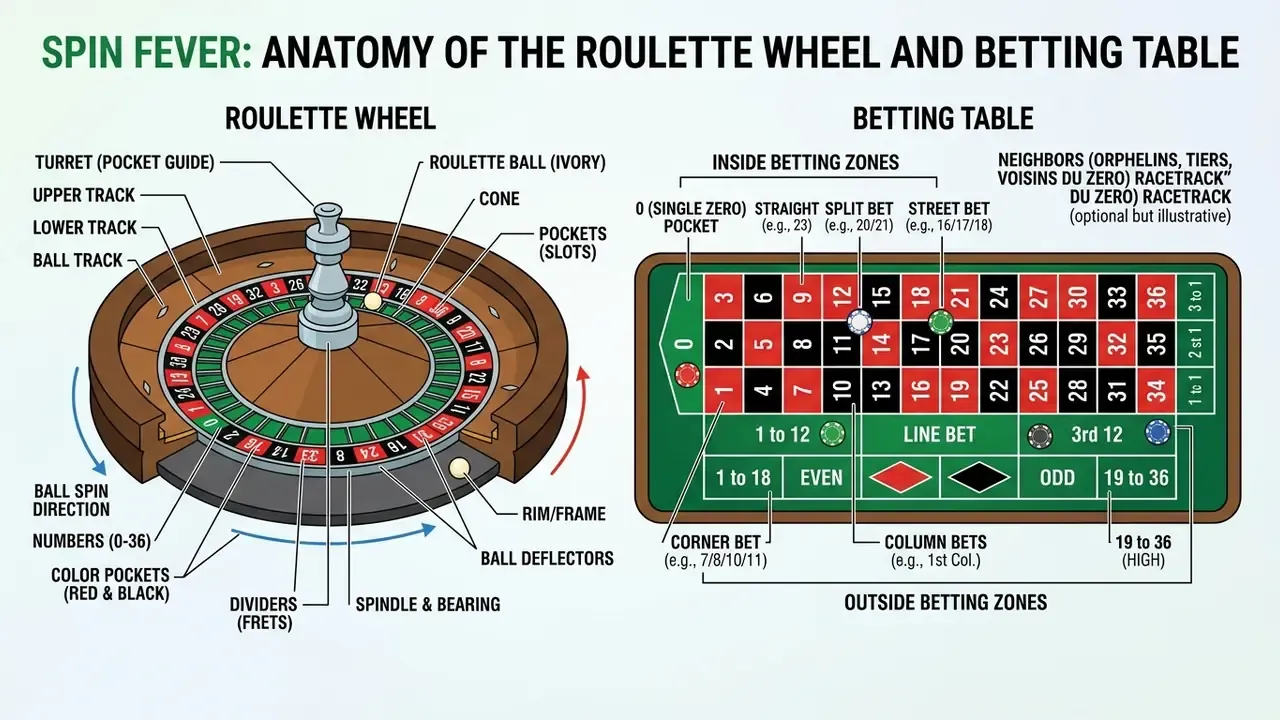
Roulette wheel and betting table layout in European and American formats
The Roulette Wheel, the Table and

The Roulette Wheel, the Table and the Dealer's Role

The roulette wheel is a precision-engineered circular device featuring alternating red and black numbered pockets from 1 to 36, along with one or two green zero pockets. Numbers are not arranged in ascending order. They follow a fixed sequence around the rim, designed to distribute high, low, red and black numbers evenly. The layout of the roulette table mirrors the wheel's numbers in a structured grid, surrounded by outer betting boxes for proposition wagers such as odd or even and red or black.

In traditional and live settings, the dealer roulette operator spins the wheel in one direction while launching the ball in the opposite direction along the outer track. The dealer manages the table tempo, announces the end of betting, records the winning pocket when the ball comes to rest, and executes payout distributions according to established house rules. Regulated venue rules also require table minimums and maximums to be displayed at the table itself, and wagers must be made with approved chips rather than any other token.

The Objective of the Game and

The Objective of the Game and the Sequence of a Single Spin

The primary objective in a roulette game is to predict which numbered pocket the ball will occupy at the end of a spin. A single round follows a strict sequence: players place chips on the table grid, the dealer or software initiates the spin, betting is formally closed, the ball settles into a pocket, and winning bets are settled automatically or manually.

During the spin cycle, the ball loses momentum and drops from the upper track into the spinning wheel centre, deflecting off metal frets before coming to rest in a single pocket. The winning number determines settlement for all active bets, after which losing chips are cleared and payouts are credited before the next wagering round. Expressed as a repeatable loop, every round runs: spin, result determination, bet settlement, next round opens.

Roulette Rules How to Start Playing

Roulette Rules: How to Start Playing Roulette Online

To start playing roulette online, a player selects chip values, places them on designated table areas before the betting window closes, then waits for the wheel spin to resolve. Standard roulette rules dictate that wagers must comply with minimum and maximum table limits, and bets cannot be modified once the dealer or system closes the betting phase.

In regulated frameworks, starting a session also involves verifying account eligibility, confirming game rules and setting personal spending parameters. Editorial testing of operator interfaces suggests that clearly displayed limit information and explicit bet-confirmation prompts help players avoid unintended stakes during fast rounds. That is hands-on platform observation rather than published statistical research, so treat it as practitioner guidance and always confirm the limit display on the specific table you join.

How to Select a Chip and

How to Select a Chip and Place Bets on the Table

Selecting chip denominations means clicking or tapping chip icons that represent specific monetary values, then placing them onto the desired grid lines or betting boxes on the roulette table. Players can place bets on single numbers, groups of numbers, or broad outcomes such as red or black, provided the total wager meets the table's minimum bet requirement. Where one chip value does not match your intended stake, multiple denominations can be stacked on the same betting field.

Most online platforms require players to press a clear "Place Bet" or "Confirm" button before the timer expires. Without that confirmation the wager is not registered and is not valid. If a wager falls below the table minimum or exceeds the maximum single-bet cap, the gaming interface either rejects the chip placement or scales it down to the allowable threshold.

What Happens After the Wheel Spins

What Happens After the Wheel Spins

Once the roulette wheel spin begins and the ball is released, the digital system or live dealer announces that no more bets can be placed. The physical or virtual ball travels around the rim until it decelerates, drops into the pocket matrix and comes to a complete rest in a winning sector.

The winning number and its attributes (colour, parity, range) are then highlighted on screen. The automated game system calculates winnings, collects losing stakes, credits player balances according to fixed payout ratios, and opens a brief window for placing bets on the next round. In fast live formats that window can be under 15 seconds, which is worth knowing before you try to build a complex bet spread.

Roulette Bets Inside and Outside Bets

Roulette Bets: Inside and Outside Bets, Odds and Payouts

Roulette wagers split into inside bets, which cover specific numbers or small number groups with higher payouts and lower probabilities, and outside bets, which cover larger categories with better winning odds and smaller payouts. Understanding payout ratios and probabilities is essential for managing session risk and bankroll exposure.

In standard European roulette, the house edge across all standard bets is 2.70%, stemming from the single green zero pocket (1/37 = 2.70%). American roulette introduces a double zero, lifting the edge to 5.26% (2/38 = 5.26%). Payout ratios remain identical across both variants, which means american roulette offers lower statistical winning odds for exactly the same return.

"Australian regulators treat roulette as a fixed-house-edge product: no betting pattern changes the negative expected value of a wager." (Grattan Institute, A better bet: How Australia should prevent gambling harm, 2024). https://grattan.edu.au

Type of BetBet NameCovered NumbersWinning Probability (European / 37 pockets)Winning Probability (American / 38 pockets)Payout Ratio
InsideStraight Up / Single1 number2.70% (1/37)2.63% (1/38)35:1
InsideSplit2 numbers5.41% (2/37)5.26% (2/38)17:1
InsideStreet3 numbers8.11% (3/37)7.89% (3/38)11:1
InsideCorner4 numbers10.81% (4/37)10.53% (4/38)8:1
InsideSix Line6 numbers16.22% (6/37)15.79% (6/38)5:1
OutsideColumn12 numbers32.43% (12/37)31.58% (12/38)2:1
OutsideDozen12 numbers32.43% (12/37)31.58% (12/38)2:1
OutsideRed / Black18 numbers48.65% (18/37)47.37% (18/38)1:1
OutsideEven / Odd18 numbers48.65% (18/37)47.37% (18/38)1:1
OutsideHigh / Low (19 to 36 / 1 to 18)18 numbers48.65% (18/37)47.37% (18/38)1:1

The table reads in one direction: the more pockets a bet covers, the more often it wins and the less it pays.

Inside Bets Wagers on Single Numbers

Inside Bets: Wagers on Single Numbers and Combinations

Inside bets sit on the inner numbered grid of the table layout, offering high payouts to compensate for low winning probabilities. A Straight Up bet covers a single number for 35:1, while a Split covers two adjacent numbers for 17:1.

Further inside options include Street bets (three numbers in a row at 11:1), Corner bets (four adjoining numbers at 8:1) and Six Line bets (two adjacent rows at 5:1). Some wheels also offer basket or trio bets, which exist only on certain layouts and should be checked against the published paytable. Because these wagers cover so few pockets, session variance rises sharply when you rely mainly on inside positions. A run of 40 losing spins on a straight-up bet is unremarkable, not unlucky.

Outside Bets Colour, Parity, Ranges and

Outside Bets: Colour, Parity, Ranges and Columns

Outside bets sit on the perimeter of the betting board and cover broad characteristics of the winning number, giving lower variance and higher win frequency. Even-money wagers such as Red or Black, Odd or Even, and Low (1 to 18) or High (19 to 36) pay 1:1 and cover 18 pockets. On both single-zero and double-zero wheels, every outside bet loses when the ball lands in 0 or 00, and that is precisely where the house edge lives.

Dozens and Columns let players cover 12 numbers at once for a 2:1 payout. Returns per winning round are smaller, yet these outside bets are widely used by players who want steadier bankroll progression and shorter losing streaks during play roulette sessions. Steadier, note, not safer in the long run. The edge is unchanged.

Types of Roulette Games European, American

Types of Roulette Games: European, American and French Roulette

The principal variants of roulette games are european roulette, american roulette and french roulette, which differ in wheel configuration, table rules and overall house edge. Choosing the variant is the single decision with the clearest effect on expected returns over a long series of sessions.

[💬 PULL QUOTE: "Choosing between European and American roulette is not a matter of style; it is a mathematical decision. The additional double-zero pocket on American wheels nearly doubles the house edge, reducing long-term return-to-player rates." Claire Bennett, Senior iGaming Content Editor]
European Roulette and French Roulette. European

European Roulette and French Roulette

European roulette uses a 37-pocket wheel with a single green zero, producing a standard house edge of 2.70%. French roulette runs the identical 37-pocket single-zero wheel, but adds specialised rules, La Partage and En Prison, applied to even-money outside bets when the ball lands on zero.

Under La Partage, half of an even-money wager is refunded when zero appears. Under En Prison, the wager stays locked on the table for a further spin: win the next spin and the stake is released, lose it and the whole wager is forfeited. Both rules cut the effective edge on even-money bets in french roulette to roughly 1.35% (2.70% divided by 2), which makes it the strongest standard variant on the maths.

"Australian research classifies roulette among fixed-edge casino games, where choosing a lower-edge variant reduces expected losses." (Australian Institute of Family Studies, Gambling Activity in Australia, HILDA Survey data, 2024). https://aifs.gov.au

American Roulette and Non-Standard Variations Mini

American Roulette and Non-Standard Variations (Mini, Multi-Ball, Multi-Wheel)

American roulette adds a 38th pocket containing a double zero (00), positioned opposite the single zero on the rim. That one structural addition lifts the casino house edge to 5.26% on all standard wagers, cutting win probabilities without lifting payouts by a cent.

Modern online casinos also run proprietary and non-standard formats that alter game speed and volatility, so published paytables need a careful read:

  1. Mini Roulette. The wheel shrinks to 13 pockets (0 to 12). When the ball lands on "0", half of all even-money stakes are returned to the player, a mechanic functionally similar to La Partage. Bets are placed exactly as on a full-size layout, but the shortened grid changes both payouts and covered-number ratios, so check the paytable before staking.
  2. Multi-Ball Roulette. Up to 10 balls can be in play during one spin, and players can usually select or deselect balls until the configuration suits them. The mathematical quirk is that no two balls can settle in the same pocket, which redistributes probabilities across covered numbers. More balls mean more chances of hitting a covered number, though stake requirements scale in step.
  3. Multi-Wheel Roulette. A single bet is distributed across up to eight independently spinning single-zero European wheels. Each wheel resolves on its own, so session pace, total turnover and exposure can accelerate up to eightfold compared with one standard table.

Because these formats are vendor-defined rather than standard casino layouts, payout schedules, refund rules and stake multipliers vary between studios. Open the in-game information panel before the first spin. Every time.

Roulette Demo, Free Games and Real Money Roulette

General information notice: This content is general in nature and does not replace advice from a qualified legal or financial professional. Online gambling legislation varies by jurisdiction, and readers must confirm the rules that apply in their own location.

Legal disclaimer and E-E-A-T compliance notice: Real money online casino gambling is subject to strict age restrictions (18+ only) and local jurisdictional laws. In Australia, the Interactive Gambling Act 2001 (IGA) prohibits the provision of unlicensed online casino games, including real money online roulette, to residents physically located within the country. Australian legal frameworks under the Interactive Gambling Amendment (Credit and Other Measures) Act 2023 also prohibit the use of credit cards and digital currencies for regulated interactive wagering. Players must independently verify local legal status, bonus terms, wagering contributions and withdrawal conditions with licensed operators before making any financial transaction. If gambling is causing harm, contact the National Gambling Helpline on 1800 858 858 or register with BetStop, the National Self-Exclusion Register.

Roulette demo modes let users engage with free roulette games using virtual practice credits, whereas roulette real money play involves depositing funds, accepting financial risk and operating under licensed regulatory rules. Demo modes reproduce the mechanics without monetary settlement or any cash-out potential.

CriterionRoulette Demo (Free Play)Real Money Roulette
Financial riskZero, virtual credits onlyReal, deposited funds can be lost
Registration / KYCUsually not required, instant playAccount registration and identity verification mandatory
Live dealer accessRestricted; often view-only or unavailableFull betting access to live studio tables
Game varietyWide RNG catalogue, no live tablesFull catalogue including live and VIP tables
Bonuses and loyaltyNot applicableWelcome offers, cashback and VIP schemes available
RTP and mathsIdentical algorithms and RTP settingsIdentical algorithms and RTP settings
Strategic valueIdeal for learning rules, layouts and interface pacingTests psychological discipline, limit-setting and bankroll control
WithdrawalsNot possible, no monetary valuePossible, subject to KYC, minimums, fees and processing times
Session pressureLow; unlimited replay timeHigh; loss-chasing risk requires active limit management

When to Choose Roulette Demo and Free Roulette Games

Free roulette games and demo modes are ideal for reviewing roulette rules, testing betting layouts and getting used to interface controls without financial loss. Longitudinal research by the Australian Institute of Family Studies indicates that engagement with simulated casino games among adolescents correlates strongly with real money gambling uptake in adulthood, which is exactly why simulated modes should be treated as adult-only educational tools.

"Teenagers who played simulated gambling games at 16 to 17 were 26 percentage points more likely to bet on casino games at 18 to 19." (AIFS, Growing Up in Australia: Longitudinal Study of Australian Children, 2024). https://aifs.gov.au

In practical terms, demo play lets you gauge variance, test software responsiveness and watch payout mechanics without risking capital. It is also the safest place to watch a staking progression run across several hundred spins and see how brutally fast stake sizes escalate. What demo play cannot reproduce is the psychology: the pull of a losing session, or the temptation to top up a balance.

What to Check Before Playing Real

What to Check Before Playing Real Money Roulette

Before playing roulette real money games on any external platform, run rigorous checks on licensing credentials, table limits, wagering requirements and withdrawal processing rules. Operator terms need reading closely enough to confirm that table limits actually suit your bankroll.

When assessing promotional bonuses, inspect the game weighting schedule, because roulette wagers frequently contribute only 0% to 10% toward clearing wagering requirements. Withdrawal policies matter just as much: identity verification (KYC) thresholds, minimum withdrawal amounts, processing times, fees and method restrictions should all be confirmed before you deposit.

Where promotional pages conflict with general terms, bonus terms usually govern wagering conditions while the payments section governs cash-out handling.

Pre-deposit checklist:

  • Licence number and regulator, verifiable through the regulator's own public register.
  • Published minimum and maximum bet for each roulette table you intend to play.
  • Bonus playthrough multiplier, roulette weighting, expiry window and maximum cash-out cap.
  • KYC documents required, minimum withdrawal amount, fees and stated processing time.
  • Availability of deposit limits, session reminders, time-outs and self-exclusion tools.
Live Dealer Roulette How Live Casino

Live Dealer Roulette: How Live Casino Works

Live dealer roulette connects online players to physical studio tables through high-definition video streaming, combining a real human dealer with a digital betting interface. Unlike automated RNG roulette, live dealer games use optical character recognition (OCR) technology to capture the outcome of a real wheel spin. The appeal is verifiability: you watch a physical wheel turn rather than trusting an invisible algorithm.

Operational integrity in live casino environments depends on audited studio hardware, licensed dealer staff and low-latency data transmission. In Australian public health literature, online casino products with rapid play, isolated digital settings and continuous access are classed as high-risk formats that deserve full risk awareness.

"Around one-third of people who gamble online experience gambling harm; isolation and continuous access intensify risk in digital environments." (ACT Commission for Gambling and Racing, Young adults gambling online in the ACT, 2024). https://www.gamblingandracing.act.gov.au

The Real Dealer, the Live Table

The Real Dealer, the Live Table and the Video Stream

In a live dealer roulette studio, several high-definition cameras capture the wheel, the dealer's hands and the ball trajectory from different angles. OCR software digitises the winning pocket the moment the ball stops, then transmits the result to the server.

This setup allows automated payout calculation while preserving the visual experience of a physical casino floor. Interactive chat lets players speak to the dealer, adding a social layer that RNG tables simply do not have.

Fairness verification cycle for a single live studio spin:

  1. Capture. The OCR camera array reads the pocket where the ball has come to rest and digitises the winning number.
  2. Cross-verification. A dedicated game logic server compares the physical OCR value against the algorithmic model of the table state and expected game rules, flagging any discrepancy for control-room review before settlement.
  3. Encryption. The confirmed result and every associated wager are sealed under SSL/TLS transport encryption and sent to the client interface, creating a tamper-resistant audit trail.
  4. Settlement. The system calculates and credits payouts to each player's balance according to the published paytable, and encrypted logs sync back to the interface for verification.

Because dedicated bandwidth allocation and low-latency encoding sit between the studio and your screen, betting windows close a few seconds before the physical outcome. That gap is a deliberate integrity control, not a delay working in your favour.

Live Roulette Variants and Betting Limits

Live Roulette Variants and Betting Limits

Live casino operators run a wide spread of formats built for different player preferences and connection speeds. Popular titles include Lightning Roulette (randomised payout multipliers on straight-up bets), Immersive Roulette (multi-angle slow-motion replays), live european roulette, live french roulette and dedicated VIP tables with raised maximums. Providers rarely publish limit bands publicly, so the authoritative source is always the operator's table lobby.

Betting ranges across live tables are structured to suit different profiles, from low-stakes entry limits of roughly $0.50 to $1 per round up to VIP thresholds in the thousands per spin.

Check that your chosen live table matches your pre-set risk parameters before you join the stream.

Unlike land-based venues, where table minimums in major Australian casinos commonly start between $10 and $25 per spin, online roulette offers a far more flexible entry point. On standard RNG and live tables, minimum stakes typically begin at $0.10 to $1. High rollers are served by Salon Privé and VIP tables where upper limits generally run from $500 to $10,000 or more on a single spin, since live formats attract higher-volume players. Lower minimums are a real convenience. They also make long sessions easier to extend, so set a loss limit before play, not during it.

Roulette Strategy: How to Play Consciously

This section is general information only. No strategy guarantees a win. If you notice signs of problem gambling, contact the National Gambling Helpline on 1800 858 858 or visit Gambling Help Online.

Plenty of roulette strategy models exist, among them Martingale, Fibonacci and flat betting, and each structures a betting progression in a slightly different way. None of them alters the house edge or produces a long-term winning outcome. Roulette is memoryless: every spin is statistically independent of the last.

"Progression systems do not reduce the house advantage; they change variance, pairing frequent small wins with rare catastrophic losses." (Grattan Institute, A better bet: How Australia should prevent gambling harm, 2024). https://grattan.edu.au

Mathematical fact check and strategy verification: Every spin of a roulette wheel is completely independent of previous results. The probability of a red outcome on a European wheel is always 18/37 (48.65%), whether black has appeared 5, 10 or 20 times in a row. Progression strategies such as the Martingale system (doubling bets after every loss) do not reduce the house advantage; they alter variance by combining frequent small wins with occasional catastrophic losses once you hit the table maximum or run out of bankroll. Responsible play means treating roulette as paid entertainment, setting strict loss limits and never using borrowed funds.

"As of July 2024, around 22,000 people had registered with BetStop, half of them under 30." (Grattan Institute, A better bet: How Australia should prevent gambling harm, 2024). https://grattan.edu.au

Practical Bankroll Management and Responsible Gambling

Practical Bankroll Management and Responsible Gambling Controls

Bankroll management does not change the house edge either. What it changes is how long your entertainment budget lasts and how much of it can disappear in one sitting. Practical, verifiable steps:

  • Set a session budget before you open the lobby, and treat it as the cost of entertainment rather than an investment.
  • Prefer single-zero tables (european roulette, or better, french roulette with La Partage) because the edge is structurally lower.
  • Use flat stakes as the lowest-variance approach, and avoid doubling progressions that collide with table maximums.
  • Configure deposit limits in your account settings, usually under Account, Responsible Gambling, Deposit Limits, before your first deposit. Increases normally require a cooling-off period, while decreases apply immediately.
  • Activate session reminders and reality checks so elapsed time and net position appear at fixed intervals.
  • Use a time-out (a short-term account freeze) if you notice loss-chasing, and BetStop for national self-exclusion across licensed Australian interactive wagering services.
  • Never gamble with credit or borrowed funds. In Australia, credit cards and digital currencies are prohibited for regulated interactive wagering under the 2023 amendments.

Once your limits and variant preference are set, the remaining variable is the platform itself. That is where compliance checks matter far more than any headline bonus figure.

How to Choose a Roulette Casino for Online and Live Play

Selecting a reputable roulette casino means assessing legal licensing status, game diversity, bonus transparency, withdrawal speed and built-in responsible gambling controls. Independent evaluation frameworks put platform safety and procedural compliance ahead of promotional claims, and so does this guide.

"In 2023 to 2024 Australians lost more than $32 billion on legal forms of gambling, the highest per-capita losses in the world." (Australian Government Response to the House Committee report You win some, you lose more, 2026). https://www.infrastructure.gov.au

[❓ QUIZ: Roulette casino selection checklist. Five questions assessing platform reliability, payout rules and limit tools. Results lead to three reliability tiers.] Purpose: Helps the reader evaluate an offer's real value and select a suitable platform before taking action. Semantic markup: section element with role form and aria-label "Casino Verification Checklist", containing a definition list with the assessment criteria: licence, bonus terms, payout speed, table limits, mobile experience. All items and results must be duplicated as text in the DOM.

Methodology for casino evaluation (E-E-A-T framework): When assessing online casino platforms that offer roulette, editorial reviews apply a standardised scoring matrix across three pillars.

  1. Regulatory compliance and security: verification of official licensing credentials (for example UKGC, MGA), active TLS encryption, verified RNG audit certificates (eCOGRA, iTech Labs, GLI) and adherence to local compliance guidelines.
  2. Terms transparency and bonus integrity: detailed inspection of wagering multipliers, maximum cash-out caps, game eligibility schedules (specifically verifying roulette contribution percentages) and hidden expiry terms.
  3. Payment efficiency and player protections: verification of cash-out processing speeds, KYC friction, availability of fast payout channels and accessible responsible gambling tools (self-exclusion, deposit limits, BetStop compatibility).
Games, Offers, Bonuses and Limits. A

Games, Offers, Bonuses and Limits

A complete roulette platform should supply a broad software catalogue covering european roulette, french roulette, american roulette and live dealer options, ideally with a demo mode for each RNG title. When you review welcome offers, read the fine print rather than the match amount.

Bonus terms often restrict roulette contribution to minimal levels, commonly 5% to 10%, which means a $10 bet on roulette may count as only $0.50 or $1.00 toward playthrough. Table limits matter for the same practical reason: conservative bettors and higher-volume players need different ranges to stay inside comfortable bankroll boundaries.

"Check bonus conditions and wagering requirements before depositing; these terms determine the real value of an offer." (Australian Government Response to the House Committee report You win some, you lose more, 2026). https://www.infrastructure.gov.au

Who should skip the welcome bonus

Who should skip the welcome bonus entirely:

  • Roulette-only players. At 5 to 10% weighting, a $100 bonus with a 35x requirement means $35,000 to $70,000 of roulette turnover. Functionally unclearable for most bankrolls.
  • Players who intend to withdraw quickly. Accepting a bonus typically locks your deposit until playthrough is complete.
  • Anyone using low-stake outside bets. Many bonus terms explicitly void wagers that cover a large share of the table, betting both red and black being the classic example, and that rule catches most even-money approaches.
  • Players sensitive to maximum cash-out caps. A capped bonus win can turn a large result into a modest payout.

If any of those describe you, decline the offer and play with cleared cash. The freedom to withdraw whenever you like is usually worth more than the nominal bonus value.

Mobile Roulette and Fast Payouts. Modern

Mobile Roulette and Fast Payouts

Modern online roulette platforms need fully responsive browser architecture or native roulette apps for iOS and Android. Mobile interfaces require touch-optimised betting boards, clear visual scaling, adequate touch-target sizing and stable stream performance over ordinary mobile networks. Accessibility benchmarks such as WCAG 2.2 expect layouts to reflow without loss of information down to roughly 320 CSS pixels, which is a handy proxy for judging whether a betting grid is genuinely mobile-ready or just shrunk.

Fast payouts are a strong reliability signal. Industry practice calls for clear identity verification protocols and prompt processing windows; push-to-card payout rails commonly target funds availability within about 30 minutes of internal approval, although real timing varies by payment rail, bank and verification status. Treat the withdrawal window published in the payments terms as the binding commitment, not the marketing copy on the promo page.

"The financial wellbeing of people who gamble is on average lower than that of non-gamblers; fast payouts can encourage funds to be reinvested in play." (Grattan Institute, A better bet: How Australia should prevent gambling harm, 2024). https://grattan.edu.au

How to Recognise a Blacklisted Roulette

How to Recognise a Blacklisted Roulette Casino: Scam Warning Signs

Avoid operators showing any of the following red flags:

  • Payout delays. Withdrawal processing beyond 14 to 30 days without a documented regulatory reason; in genuinely rogue operations, players have reported waits of 18 months or more.
  • Account closures without notice. Balances zeroed and accounts blocked under vague "suspicious activity" claims, with no logs, evidence or appeal pathway.
  • Fake or misleading licensing. Licence numbers shown as plain text with no clickable link to the regulator's validator, or licensing claims the public register does not confirm.
  • No RNG certification. Games lack published testing reports from eCOGRA, iTech Labs or GLI, and live tables name no identifiable studio provider.
  • Unresponsive or unprofessional support. No live chat, generic template replies, or complaints left unanswered for weeks.
  • Reports of winnings not being paid. Consistent, independently documented complaints about unpaid balances.
  • Terms that change retroactively. Bonus or withdrawal rules amended after a win and applied to a completed session.

Any single item warrants caution. Two or more together should be treated as disqualifying.

How Australian Players Can Verify a

How Australian Players Can Verify a Site Before Depositing

  1. Check the ACMA position. Search the ACMA website for published enforcement actions and blocked-service listings, and read the current guidance on illegal offshore gambling. If a service appears in enforcement material, do not deposit.
  2. Validate the licence at the source. Copy the licence number from the casino footer and look it up on the regulator's own register, for example the MGA or UKGC public licensee search. Never rely on a logo image.
  3. Confirm the corporate entity. The licensed company name in the terms should match the entity listed on the regulator's register.
  4. Test support before depositing. Ask one specific question about roulette bonus weighting and withdrawal timing. Vague or evasive answers are diagnostic.
  5. Read the payments page in full. Note minimum withdrawal, fees, KYC triggers and stated processing windows.
  6. Verify player protection tools. Deposit limits, time-outs, session reminders and self-exclusion should be reachable inside account settings, not only on request.
  7. Do a small first withdrawal. Complete KYC and test a modest cash-out before committing a larger bankroll.

FAQ About Roulette Online

What to Do Next. 1. Learn

What to Do Next

  1. Learn on the house. Spend 20 to 30 spins in a free european or french roulette demo, confirming that you can read the layout, set chip values and spot the betting window before it closes.
  2. Choose your variant on maths, not looks. Default to single-zero tables, and prefer french roulette with La Partage where it is available.
  3. Write down your limits before you deposit. A session budget, a loss limit and a time cap, then configure them inside account settings so the platform enforces them rather than your willpower.
  4. Run the verification checklist. Licence lookup on the regulator's register, ACMA guidance check, payments terms read in full, and a small test withdrawal.
  5. Skip the bonus if you only play roulette. Cleared cash with instant withdrawal rights usually beats an offer weighted at 5 to 10%.
  6. Know where help is. National Gambling Helpline 1800 858 858, Gambling Help Online, and BetStop for national self-exclusion.

This guide is general information for readers aged 18 and over and is not legal, financial or medical advice. Gambling involves risk of financial loss; outcomes are random and past results never influence future spins.