Spin Fever

Mines: Play Online in Demo Mode and for Real Money

Author: Claire Bennett, Senior iGaming Content Editor · Last reviewed and updated: January 2026

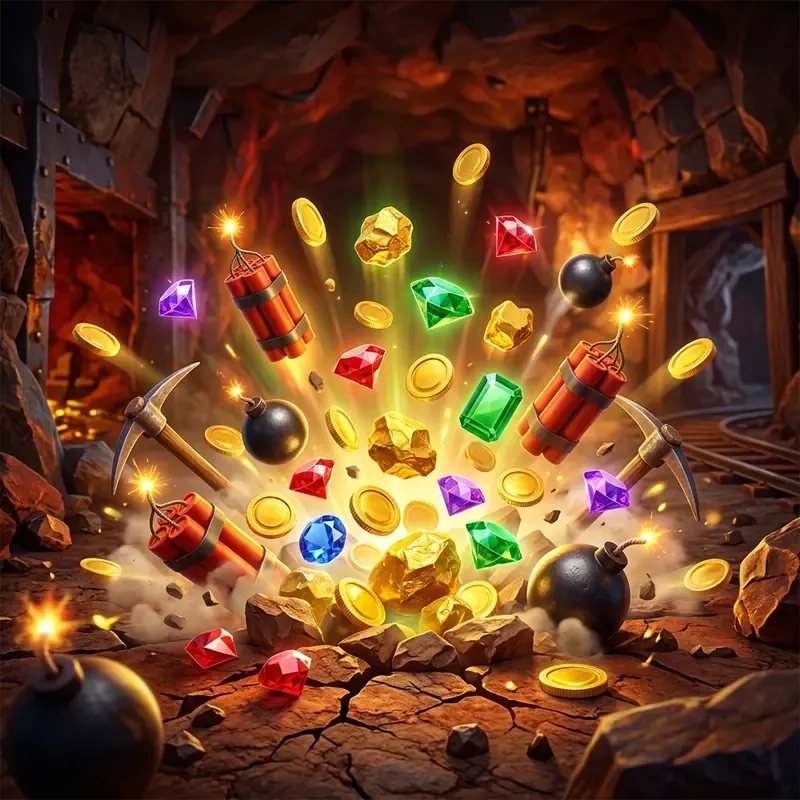
Mines is a grid-based instant casino game. Players open hidden tiles on a 5×5 board to reveal multipliers while trying to avoid buried mines. The core mechanic rests on adjustable risk: you pick the number of mines before the round starts, every safe tile lifts the payout multiplier, and you may cash out at any point you like.

«A transparent review of instant casino games begins with fine print, volatility mechanics and mathematical probability rather than headline multipliers. Evaluating payout rules, local regulatory boundaries and bankroll controls is essential before placing any real money stake.» — Claire Bennett, Senior iGaming Content Editor
Provider

Spribe

RTP

97.00%

Volatility

High

Min bet

$0.10

Max bet

$100

Max win

10,000x

Mines Play Online in Demo Mode
Table of ContentCloseOpen
Mines in ten lines the short

Mines in ten lines: the short version

  • Board:5×5 grid, 25 covered tiles, no numeric hints (unlike classic Minesweeper).
  • Mine range:1 to 24 mines, chosen by the player before the round begins.
  • RTP:roughly 96.00% – 97.00% on Spribe, Turbo Games and Hacksaw Gaming builds; 99.00% on the Stake Originals in-house version.
  • House edge:1.00% – 4.00% depending on the provider's configuration.
  • Multiplier logic:combinatorial. More mines means fewer safe tiles, so each safe reveal pays more.
  • Cash out:available after every successful pick; manual or automatic (Auto Cash-Out).
  • Fairness:certified RNG or Provably Fair commit-reveal using Server Seed, Client Seed and Nonce (SHA-256/SHA-512).
  • Demo mode:virtual credits, identical mathematics in certified titles, zero financial exposure.
  • Strategy reality check:no staking system, whether Martingale, Paroli or the “10 Bets” ladder, removes the negative expected value.
  • Australia:online casino games are restricted under the Interactive Gambling Act 2001; 18+ only, with self-exclusion available through BetStop.
What Mines game is and why

What Mines game is and why players choose it

Mines is an instant casino game built on a 5×5 grid of 25 covered tiles. It combines adjustable volatility, dynamic multiplier growth and an instant cash out feature. The main appeal sits in player control: unlike traditional slots with fixed reel outcomes, these instant casino games let you set the exact number of hidden mines (usually between 1 and 24) and decide precisely when to end the round and bank the current win.

Every unopened tile hides either a safe multiplier value or a mine. Opening a safe tile raises the total payout multiplier, calculated from the remaining unrevealed safe cells. Hit a mine and the round ends immediately, with the stake lost. Provider specification sheets for Spribe, Turbo Games and Hacksaw Gaming builds list a baseline Return to Player (RTP) near 97.00%.

Spribe's Mines, released in 2021, is catalogued with a fixed 97% RTP, a 5×5 layout and stakes from $0.10 to $100, which makes it a mathematically predictable instant product with negative expected value. Where a provider does not publish a certified RTP sheet, treat the figure as unverified until the operator supplies the certification report.

«In 2024, 36% of Australian adults gambled online, up from 32% in 2023.» — ACMA, How we use the internet (2024). https://www.acma.gov.au/how-we-use-internet

That growth in online participation explains why instant products such as Mines now sit at the front of most casino lobbies. Rounds resolve in seconds, stakes can start below one dollar, and the interface behaves the same on desktop and mobile. No spin animation, no bonus round, no waiting.

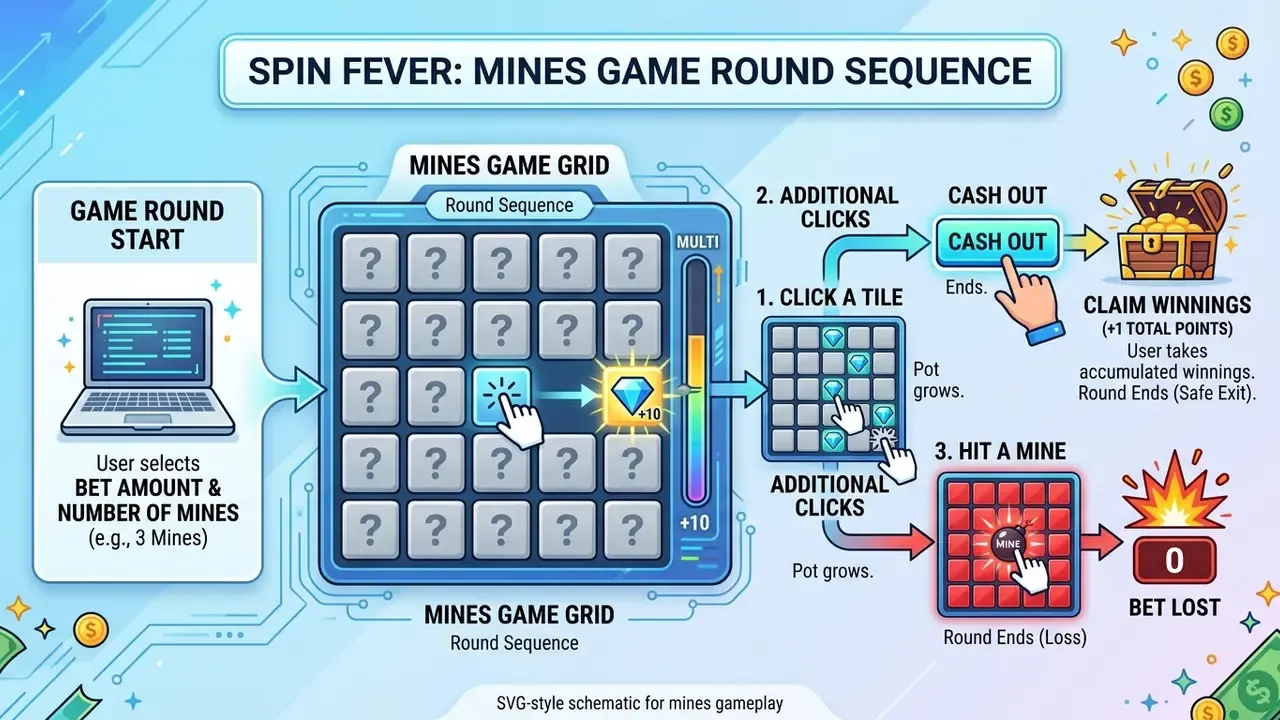
mines game round sequence diagram
Set the stake  →  Choose the mine count (1–24)  →  Open tiles one by one
      ↓                                                    ↓
  Bankroll rule                                    Multiplier increases
                                                            ↓
                                     Cash Out (win locked)  |  Mine hit (stake lost)

The Mines round sequence: from parameter selection to locking in a payout.

How Mines differs from classic Minesweeper

How Mines differs from classic Minesweeper

The casino game Mines differs from classic Windows Minesweeper because it is a probabilistic gambling game with financial stakes, published RTP specifications and voluntary early payouts, not a deterministic logic puzzle. In classic Minesweeper you use numerical proximity clues to clear an entire grid without a monetary wager, and the game ends only when every non-mine cell is identified.

Casino Mines, by contrast, requires a real money or demo stake per round and gives no numerical hints about adjacent mines. The objective is not to clear the whole 5×5 board. It is to survive a sequence of independent random selections and execute a cash out before a mine appears.

Classic Minesweeper has no monetary return model at all. Microsoft's documentation treats it purely as a puzzle and never assigns an RTP, because there is nothing to return. Casino Mines runs on a certified RNG or Provably Fair engine with a house margin derived directly from the configured RTP: 1.00% at 99.00% RTP, 3.00% at 97.00% RTP and 4.00% at 96.00% RTP. The distinction is legal as well as mathematical.

«Gambling requires three elements: consideration (a stake), chance and a prize of value.» — Interactive Gambling Act 2001 framework, ACMA interactive gambling guidance. https://www.acma.gov.au/interactive-gambling

Minesweeper satisfies only the second of those three elements. Casino Mines satisfies all three, which is exactly why it falls inside Australia's interactive gambling rules while the desktop puzzle sits well outside them.

How the multiplier is formed in

How the multiplier is formed in Mines

The payout multiplier in Mines is built on combinatorial probability. It rises with every consecutive safe tile opened, and it climbs faster when a higher number of mines is selected. The mathematical fair multiplier for a 5×5 grid (25 total tiles) containing $N$ hidden mines after $s$ safe reveals comes from the inverse probability of that specific combination:

$$\text{Fair Multiplier} = \frac{\binom{25}{s}}{\binom{25-N}{s}}$$

Because the operator keeps a house margin (RTP usually set around 97.00%), the multiplier shown in the interface equals the fair multiplier times the provider's RTP coefficient (0.97). Selecting more mines cuts the count of available safe tiles, so the multiplier progression curve scales steeply even after one or two successful picks.

How to use a Mines probability

How to use a Mines probability calculator

Mines calculators let you price a round before you stake anything. Instead of guessing whether “three picks with five mines” is reasonable, you compute the exact survival probability and compare it with the multiplier on offer. Three inputs are required:

  1. Grid size: 25 tiles (5×5).
  2. Mine count ($N$): any value from 1 to 24.
  3. Target reveals ($s$): how many safe tiles you intend to open before cashing out.

The probability of $s$ consecutive successful clicks is the product of the shrinking safe-tile ratios:

$$P(s) = \prod_{i=0}^{s-1} \frac{25 - N - i}{25 - i}$$

Worked example (5 mines, 3 reveals):

$$\frac{20}{25} \times \frac{19}{24} \times \frac{18}{23} = 0.8000 \times 0.7917 \times 0.7826 = 49.56%$$

So a three-pick run with five mines succeeds slightly less than half the time. Multiply your target multiplier by that probability and by the provider RTP coefficient, and you can see whether the offered payout is fair or merely flattering. Two limits matter, though. A calculator cannot know where the mines sit, and it has no effect whatsoever on the house edge, which stays fixed at the provider's configured level.

How to play Mines online: a step-by-step order of actions

To play Mines online you set a round stake, configure the mine density, select covered tiles one at a time, then decide whether to collect the accrued win or keep opening cells. The interface recalculates the multiplier after every successful selection, so potential payouts and remaining grid risk stay visible throughout.

Before any real money wager, spend a few minutes with the manual controls, the automatic pick option and the cash out confirmation button. Muscle memory is worth more here than theory.

First-launch checklist

1
Set the stake amount: enter the bet value in the stake field, staying inside your bankroll limits.
2
Select the mine count: choose how many hidden mines sit on the 25-tile grid (for example 1, 3, 5 or 10 mines).
3
Start the round: press “Bet” or “Start Game” to lock the parameters and generate the board seed.
4
Reveal safe tiles: click individual covered tiles on the 5×5 board to uncover safe symbols and raise the multiplier.
5
Execute cash out: press “Cash Out” at any point to secure accumulated winnings before hitting a mine.
6
Optional, configure Auto Cash-Out: pre-set a target multiplier or tile count so the round settles by itself.
Choose your stake and the number

Choose your stake and the number of mines

To start a round of Mines, pick a comfortable stake size and choose a mine parameter between 1 and 24 on the 25-tile layout. That single setting decides both the difficulty of the round and how quickly the payout multiplier grows.

Fewer mines (say 1 to 3) create a low-volatility environment where the large majority of tiles are safe, producing steady but modest multiplier steps. A high mine count (10 to 20) creates an aggressive environment where opening a single tile already yields a substantial multiplier, while the chance of hitting a hidden mine on the very first pick climbs sharply. Neither setting is “better”. They simply buy different shapes of variance.

Reveal safe tiles and lock in the result

Once the round begins, click covered grid tiles one at a time and watch the dynamic payout tracker in the interface. Each safe reveal updates the accumulated multiplier and shows the exact cash value available for immediate collection.

You are never obliged to clear the board or reach any particular tile count. The cash out control stays active after every successful pick, allowing instant settlement of the round balance. If an opened tile hides a mine, the round ends at once, the interface exposes all remaining mine positions across the 5×5 grid, and the initial stake goes to the house.

How to start without a real stake

To play Mines without financial risk, launch the game in free demo mode, which uses virtual credits to replicate the interface and the grid mathematics. Demo access lets you evaluate control layouts, test different mine counts and watch multiplier growth dynamics without depositing funds.

Nearly all major suppliers, including Spribe, Turbo Games and Hacksaw Gaming, build their demo versions on identical presentation layers. Testing in demo mode gives a practical feel for how fast volatility scales when you push the mine parameter upward. Ten minutes at 15 mines teaches more than any chart.

Mines demo: how to play free before real money

Mines demo is a risk-free practice mode. It uses virtual credits to mirror the grid layout, the mine adjustment settings and the multiplier progression of the paid version. Demo play lets you test software stability, rehearse manual cash out timing and get used to the game's pace without monetary loss.

Demo is a legitimate learning tool. The research literature also flags a behavioural trap: free-play modes that pay out more generously than the paid product can distort staking decisions later on.

«Participants who played demo games with inflated RTP subsequently placed significantly larger real-money bets.» — Experimental study of online slot demo modes (128 participants aged 18–24), cited in Australian evidence synthesis 2023–2025, Addictive Behaviours. https://www.sciencedirect.com/journal/addictive-behaviors

The practical takeaway is narrow but firm: treat demo sessions as interface and volatility training, never as a forecast of financial outcomes.

What you can test in Mines

What you can test in Mines demo mode

In the Mines demo version you can freely adjust the mine configuration, try automatic tile selection features and monitor simulated bankroll swings across longer practice sessions. Demo functionality also allows full testing of interface controls on both desktop and mobile viewports.

Key parameters worth inspecting in demo mode:

  • Mine density selection:watch how the multiplier curve shifts when you move from 1 mine up to 20+ mines on a 25-tile grid.
  • Interface mechanics:compare single-tile manual selection with the automated random tile pick feature.
  • Cash out functionality:observe how instant settlement commands execute relative to interface latency.
  • Auto Cash-Out rules:set a target multiplier (2.00x, for instance) and confirm the round closes automatically.
  • Autoplay behaviour:confirm that autoplay changes convenience only. It never alters the odds of a safe tile.
  • Virtual balance tracking:track how different risk models affect mock bankroll longevity over 50 to 100 simulated rounds.
  • Balance reset:most demo builds let you top up virtual credits, which is exactly why demo sessions feel emotionally different from funded play.

Mines demo vs real money version

Mines demo mode reproduces the visual interface and the tile selection flow of the real money game. The critical differences sit elsewhere: financial risk, psychological pressure and account requirements. Demo play runs on renewable virtual credits with no monetary value, so balance depletion carries no consequence.

Feature / parameterMines demo modeMines real money mode
Balance typeVirtual credits (rechargeable)Real currency funds
Financial riskZero financial exposureRisk of losing the entire stake
Account requirementOften accessible without sign-upRequires a verified account and KYC
Psychological stressVery low (casual testing)High (emotional risk response)
Monetary cash outUnavailablePayouts credited to balance
Bonuses and promotionsNot applicableDeposit-linked, subject to wagering terms
RTP and mechanicsIdentical maths model (in certified games)Certified RNG with published RTP

«Adolescents who played social casino games were 2.5 times more likely to meet criteria for gambling disorder than non-players.» — Hing et al., Not all games are created equal, Addictive Behaviours (2023). https://www.sciencedirect.com/journal/addictive-behaviors

Note: certified demo titles mirror real money RNG logic, but decision-making does not transfer. Our editorial testing across regional operator lobbies for a multi-brand iGaming review project recorded a consistent pattern. Cash outs happen noticeably earlier once real capital is at stake. That is an internal observation from a limited sample rather than a controlled study, and it is offered as practitioner experience, not evidence.

General information disclaimer: This information is general in nature and does not replace professional advice. Demo mode does not predict the outcomes of real-money wagers.

Responsible gambling disclaimer: Real money gambling involves significant financial risk and can lead to monetary loss. Demo mode play is provided solely for educational and entertainment purposes; successful outcomes in free demo practice do not guarantee, predict or correlate with positive results in real money play. Online gambling is strictly restricted to adults aged 18+ (or 21+ depending on jurisdiction). Always set strict deposit limits and never gamble with money you cannot afford to lose.

What our test panel says about the Mines demo

Three reviewers on our editorial test panel ran the demo across desktop and mobile for a week. They rated interface clarity rather than outcomes:

«The mine slider is the whole game. Being able to move from one mine to fifteen and immediately see the multiplier table redraw made the volatility concept obvious within five minutes.» — Daniel W., software tester, editorial test panel

«Controls are large enough for one-handed mobile play, and the cash out button never moved position between rounds. That consistency matters when rounds last eight seconds.» — Priya N., UX researcher, editorial test panel

«Visually plain compared with slots, but the payout tracker is honest. You always see the exact dollar figure available before the next click.» — Marcus H., accountant, editorial test panel

Mines real money: stakes, payouts and risks

Disclaimer: This information is general in nature and does not replace professional advice. Real-money wagering carries financial risk; always set deposit limits and use responsible gambling tools.

Real money Mines play means wagering actual currency, where every round has a direct financial consequence governed by provider RTP specifications and random number generator (RNG) algorithms. Payouts equal the active stake multiplied by the accumulated multiplier at the exact moment you press cash out.

When you assess a real money version, verify operator licensing, minimum and maximum stake limits, withdrawal conditions and whether certified Provably Fair verification tools are actually available rather than merely advertised.

«One in five NSW residents (21%) experienced gambling harm; online casino games rank among the top five sources of that harm.» — NSW Gambling Survey 2024, Central Queensland University / NSW Responsible Gambling Fund. https://www.gambleaware.nsw.gov.au/research-and-resources/research/nsw-gambling-survey

Risk levels by mine count

Level of riskMine count (5×5 grid)Multiplier scale speed1st tile safety probabilityRecommended cash out focus
Low risk1 – 2 minesSlow, steady increment92.0% – 96.0%Moderate runs (3–6 tiles)
Medium risk3 – 5 minesBalanced growth80.0% – 88.0%Early to mid cash out (2–4 tiles)
High risk10 – 15 minesRapid exponential spike40.0% – 60.0%Very early cash out (1–2 tiles)
Extreme risk20+ minesMassive multiplier per tile16.0% – 20.0%Immediate cash out (1 safe tile)

Table breakdown: the probability of uncovering a safe tile falls steeply as the mine count rises. Higher mine settings advertise substantial headline multipliers, yet the statistical likelihood of forfeiting the stake on the first pick scales right alongside them.

How the number of mines affects risk and reward

The number of hidden mines you choose before a round is the primary volatility control in Mines. It drives both the safe pick probability and the steepness of the reward curve. Fewer mines mean more safe tiles on the 25-cell grid, which raises the odds of surviving early picks while flattening each multiplier step.

Take a standard 5×5 board with 10 mines: 15 safe tiles against 10 mines. The probabilities for consecutive successful picks work out as follows:

Spin Fever heading-banner
  • 1 safe tile pick:$\frac{15}{25} = 60.00%$ probability.
  • 3 safe tiles consecutive:$\frac{15}{25} \times \frac{14}{24} \times \frac{13}{23} = 13.82%$ probability.
  • 5 safe tiles consecutive:$\frac{15}{25} \times \frac{14}{24} \times \frac{13}{23} \times \frac{12}{22} \times \frac{11}{21} = 3.42%$ probability.

Those figures make the point better than any warning. Chasing five consecutive safe opens with 10 mines succeeds under 3.5% of the time. At the extreme end, 24 mines leaves exactly one safe tile: a 4% chance of a single successful click, paired with the largest multiplier the game can print.

RTP, randomness and provably fair in Mines

Mines carries a theoretical Return to Player usually configured between 96.00% and 97.00%, so the house keeps a statistical edge of 3.00% to 4.00% across millions of independent rounds. Individual sessions swing wildly. The underlying return still stays negative over long-term play.

Comparison of Mines builds by provider

Provider / platformTheoretical RTPAdvantages and featuresMine range
Stake Originals99.00%Lowest house edge (1%), crypto micro-stakes below $0.011 – 24
Spribe97.00%Widest casino distribution, autoplay, Auto Cash-Out, $0.10–$100 stakes1 – 20
Turbo Games97.00%Configurable grids, turbo round speed1 – 24
Hacksaw Gaming96.00% – 97.00%Strongest presentation layer, extra multiplier features1 – 20
For context on why instant games

For context on why instant games attract experienced players, the same Mines maths at 99.00% RTP compares favourably with mainstream slots: Gates of Olympus at 96.50%, Sweet Bonanza at 96.48%, Fruit Party at 96.47%. A one-percent house edge is still a negative expectation. It simply erodes a bankroll more slowly than a 3.5% edge over the same number of rounds. Always confirm the RTP printed in the game's own information panel, because operators sometimes deploy lower-RTP configurations of an identical title.

To protect game integrity, modern instant titles implement Provably Fair cryptographic algorithms built on Client Seed and Server Seed combinations:

Provably Fair algorithm

Server Seed (hashed pre-round) + Client Seed (player device) + Nonce (round counter)
        └─► SHA-256 / SHA-512 cryptographic hash
                └─► Deterministic grid & mine coordinates (unalterable during the round)
                        └─► Post-round reveal of the unhashed Server Seed → independent verification
  1. Pre-round commitment: before the round starts, the server generates an encrypted Server Seed hash and presents it to the client.
  2. Client input: your browser contributes a Client Seed (customisable or randomised) alongside a round counter (Nonce).
  3. Deterministic unveiling: the combination of Server Seed, Client Seed and Nonce produces a cryptographic hash that fixes the mine locations on the 5×5 grid.
  4. Post-round verification: after the round ends, the unhashed Server Seed is released, so you can verify in an independent calculator that mine positions were predetermined and never moved mid-play.

Because the hash is a commitment made before the stake is accepted, neither the operator nor the player can shift a mine during the round. That is the entire guarantee. Its limits deserve stating just as plainly.

E-E-A-T fact check: According to official game rules published by licensed providers such as Spribe, and regulator guidance from authorities including the UK Gambling Commission and the Malta Gaming Authority, Provably Fair technology confirms game fairness and seed immutability. It does not alter the mathematical RTP or guarantee winning outcomes.

Mines strategy: how to manage risk and bankroll

Disclaimer: This information is general in nature and does not replace professional advice. No strategy removes the mathematical house edge.

A Mines strategy is a structured system for bankroll allocation, risk containment and cash out discipline. It manages loss exposure. It does not beat the house edge. Because every tile selection is governed by certified random algorithms, no betting system or pattern hunting technique changes the game's negative expectation.

Useful player strategies therefore concentrate on budget preservation, loss caps, firm cash out targets and avoiding aggressive recovery systems.

Conservative strategy fewer mines and an

Conservative strategy: fewer mines and an early cash out

The conservative Mines strategy minimises variance through low mine density (1 to 2 mines on a 25-tile grid) and an early cash out after 2 to 4 safe reveals. It targets small, repeatable multiplier steps, roughly 1.10x to 1.35x, to keep the balance stable across a longer session.

Within that framework, players commit a fixed stake representing a tiny slice of total bankroll, say 1% to 2% per round. The approach avoids dramatic loss spikes, though one mine hit still erases the full stake, and several successful low-multiplier rounds are needed to recover it.

The “1:1” strategy (minimum risk). Set exactly 1 mine across 25 tiles, switch controls to Manual, make one single click on any tile, press Cash Out immediately. First-pick success probability is 96%, which produces the flattest variance curve the game allows. It is the cheapest way to learn the interface with funded rounds, and it is the only Mines pattern where a 1% house edge build (Stake Originals) meaningfully changes long-run outcomes. It is not a profit engine, mind you: the multiplier is minimal, and the 4% failure rate still costs a full stake each time it lands.

Paroli progression simulation (1 mine, target multiplier 2.00x+). Paroli is a positive progression. The stake doubles after a win and resets to base after a loss, so losing streaks are paid for at the smallest unit size.

RoundStake ($)OutcomeMultiplierRound profit ($)Next-step action
11.00Win2.14x+1.14Double the stake to $2
22.00Loss–−2.00Reset the stake to $1
31.00Win2.14x+1.14Double the stake to $2
42.00Win2.14x+2.28Double the stake to $4
54.00Loss–−4.00Reset the stake to $1
61.00Win2.14x+1.14Double the stake to $2
72.00Win2.14x+2.28Reset after three-step ladder
Across a 20-round Paroli cycle documented

Across a 20-round Paroli cycle documented by strategy publishers using a $1 base stake on a one-mine board, the net result was about +$1.52. A rounding error, not an income. The system's real function is procedural: it caps losses at the base unit and imposes a decision rule instead of impulse clicking. Its weakness is equally clear. Repeated failures on the third rung are hard to recover, and short winning streaks stay rare in a game where each round is independent.

The “10 Bets” staged system. A notebook-based alternative that steps down through mine densities across four series of ten rounds, with a fixed cash out threshold per stage:

SeriesMinesCash out thresholdPicks required
113 mines2.02x1 pick
28 mines2.13x2 picks
36 mines2.30x3 picks
44 mines2.05x4 picks

Each series runs at a base unit ($1). After every round you write the next stake in the row below: increase by one unit after a win, decrease by one unit after a loss, never below the table minimum. After the fourth series you return to 13 mines and repeat the cycle. The system needs no large bankroll and imposes hard structure. Like every progression, though, it only holds up in short samples and cannot overcome the configured house edge. Practitioners who publish it advise stopping after 10 to 12 completed lines.

Aggressive approach: more mines and a high multiplier

The aggressive Mines strategy chases exponential payouts by selecting a high mine parameter (5 to 15 mines) and attempting several consecutive reveals before cashing out. Volatility becomes extreme: most rounds end in loss, offset by occasional large multipliers. A mid-range variant, 5 to 7 mines with 3 picks, can return roughly 4x the stake, but it demands real bankroll discipline and suits nobody working with a depleted balance.

To run an aggressive model without draining the balance in twenty minutes, strict rules are mandatory:

Spin Fever heading-banner
  • Micro-staking:limit individual rounds to 0.5% – 1% of total available capital.
  • Predetermined cash out rules:fix the tile target or target multiplier (5.00x or 10.00x, for example) before pressing start; Auto Cash-Out enforces this mechanically.
  • Strict loss caps:set a hard session stop-loss, such as ending the session after ten lost stakes.
  • Progressive risk adjustment:reduce the mine count once a profit goal is reached, rather than escalating after a win.

«Highly volatile casino products are associated with elevated rates of gambling harm, particularly where players chase losses.» — NSW Gambling Survey 2024, Central Queensland University / NSW Responsible Gambling Fund. https://www.gambleaware.nsw.gov.au/research-and-resources/research/nsw-gambling-survey

Why patterns, predictors and Martingale do

Why patterns, predictors and Martingale do not change randomness

Pattern selection methods, “predictive” software signals and progressive doubling schemes such as Martingale cannot overcome randomness or shift the negative expected value of Mines. Every round produced by a certified RNG or Provably Fair engine is independent of everything before it.

⚠️ Myths about strategies and signal bots

  • Myth 1: signal bots and predictor apps can foresee mine locations. Fact: Provably Fair and RNG seeds are cryptographically hashed before the round begins. External applications or Telegram bots cannot decrypt server seeds or predict unrevealed tiles. Claims of “100% win signals” are fraudulent schemes, frequently paired with deposit-affiliate fraud.
  • Myth 2: visual tile patterns (corners, Z-shapes, diagonals) increase win rates. Fact: mine positions are distributed randomly across all 25 tiles. Clicking corners or geometric shapes carries exactly the same probability as clicking at random.
  • Myth 3: the Martingale doubling strategy guarantees recovery. Fact: doubling after every loss ($1 \to $2 \to $4 \to $8 \to $16 \to $32 \dots$) consumes a balance exponentially. After $n$ consecutive losses the cumulative risk is $2^n - 1$ base units. A streak of six or seven losing picks can wipe out a bankroll or breach maximum bet limits, ending in catastrophic loss.
  • Myth 4: autoplay improves the odds. Fact: autoplay changes speed and convenience only. It does not touch the RNG, the RTP or the probability of a safe tile, and faster rounds simply apply the house edge to more turnover per hour.

«Chasing losses and the belief that random outcomes are predictable are recognised markers of problem gambling in Australian research.» — NSW Gambling Survey 2024, Central Queensland University / NSW Responsible Gambling Fund. https://www.gambleaware.nsw.gov.au/research-and-resources/research/nsw-gambling-survey

How to choose a Mines casino

How to choose a Mines casino and access the offer

Choosing a safe casino to play Mines means verifying regulatory licensing, reading bonus terms for instant game applicability, checking withdrawal limits and confirming account protection standards. Judge operators on transparency and compliance rather than headline promotional banners, and make sure any shortlist consists of licensed online casinos instead of unregulated mirrors.

Australia's online gambling environment sits under strict statutory frameworks. Under the Interactive Gambling Act 2001 (IGA), the Australian Communications and Media Authority (ACMA) monitors and blocks illegal offshore casino domains. Adults researching brand options should prioritise licensed entities that publish clear terms, explicit KYC steps and accessible responsible gambling mechanisms such as BetStop, the National Self-Exclusion Register.

«Between April and December 2024, the ACMA blocked 172 illegal online casino websites, including sites offering games of this type.» — ACMA, Action on interactive gambling report series (2024). https://www.acma.gov.au/action-interactive-gambling

Licence verification is straightforward wherever a

Licence verification is straightforward wherever a public register exists. The UK Gambling Commission publishes a searchable register of licensed businesses, individuals, premises and regulatory actions, and the Malta Gaming Authority maintains an equivalent list. Payout caps and demo availability, by contrast, are not standardised by regulators. Those must be read in each operator's own terms, line by line.

☑️ Pre-deposit casino verification checklist

  • Licensing verification: confirm active registration on an official public register (MGA, UKGC or the relevant state regulator).
  • Mines demo availability: ensure free demo access is offered without forcing an immediate deposit.
  • Transparent bonus terms: check that instant and crash games contribute to bonus wagering (game weighting above 0%).
  • Payout rules and limits: verify written terms on daily and monthly withdrawal caps plus processing times.
  • Security protocols: ensure the site uses TLS 1.3 encryption and complies with PCI DSS v4.0.1 payment standards.
  • Safer gambling tools: confirm voluntary deposit limits, cooling-off breaks and self-exclusion links are available.
What to check in a bonus

What to check in a bonus and its wagering terms

Before activating a casino bonus to play Mines, read the promotional fine print with attention to wagering requirements, game contribution weightings, maximum bet caps and expiry windows. Promotions often restrict or exclude instant games from bonus wagering altogether.

Critical bonus parameters to check:

  1. Wagering multiplier (rollover): total turnover required before bonus funds convert to withdrawable cash, for example 30x or 40x the bonus amount.
  2. Game contribution weighting: many operators assign instant and crash games a low weighting (5% or 10%) or 0% toward rollover, against 100% for standard slots.
  3. Maximum stake cap: terms usually limit bet size while a bonus is active, often $5 per round. Breaching the cap can void the bonus entirely.
  4. Max cashout caps: some offers limit the total real money withdrawal from bonus winnings, whatever balance you build.

Why 5% weighting matters, a worked example. A $100 bonus with 30x wagering requires $3,000 in turnover. If Mines contributes 100%, that is $3,000 of Mines play. If Mines is weighted at 5%, every $1 wagered counts as $0.05, so clearing the same bonus demands $60,000 of turnover on the game. At a 3% house edge, the expected cost of that turnover ($1,800) is eighteen times the bonus itself. Regulatory guidance reinforces the principle: Ontario's lottery and gaming rules require bonus funds to be wagered on games with contributions above 0%, while the UK Gambling Commission permits wagering requirements on bonus winnings but prohibits tying a player's own deposited funds to bonus completion.

Payment methods available to Australian players

Payment methods available to Australian players

Deposit and withdrawal options shape the practical experience far more than any bonus banner. The methods Australian players meet most often:
  • PayID and bank transfer:near-instant local deposits linked to a mobile number or email, with withdrawals returning to the same verified account.
  • Visa and Mastercard debit:widely accepted for deposits, although some issuers decline gambling merchant codes; credit card gambling payments are restricted.
  • Neosurf and prepaid vouchers:useful as a hard spending cap, since only the loaded amount can be staked.
  • Cryptocurrency (BTC, ETH, USDT):standard on Stake Originals builds, enabling micro-stakes below $0.01 and faster settlement, with exchange-rate volatility as the trade-off.

Always match the withdrawal route to the deposit route. Most licensed operators enforce a closed-loop rule, returning funds only to the source used for the deposit, and every route sits behind identity verification.

Account, payment and game access security

Account, payment and game access security

Reputable online casinos run technical security frameworks to protect personal information, financial transactions and account access. Modern iGaming platforms should replace legacy SSL standards with TLS 1.3 (RFC 8446) to encrypt browser-to-server traffic. SSL itself is deprecated and should no longer be presented as a security feature at all.

Payment handling must comply with PCI DSS v4.0.1 (Payment Card Industry Data Security Standard) requirements for card data, including access control, monitoring and regular testing. Mandatory identity verification (KYC) then requires official photo identification and proof of address before the first withdrawal is processed, which blocks identity fraud and underage access. FATF guidance sets the baseline: customer due diligence before or during the relationship, ongoing monitoring, and screening against sanctions and PEP lists.

Security tooling only helps when it is actually used, and the usage data is sobering.

«Only 4.2% of online gamblers used temporary self-exclusion and 4.7% used permanent self-exclusion, despite broad tool availability.» — Australian Online Wagering Study, University of Sydney / NCPF parliamentary analysis. https://www.sydney.edu.au/brain-mind/our-research/addiction-research/australian-online-wagering-study.html

Deposit limits, cooling-off periods and BetStop registration take under five minutes to configure. They are also the only controls that keep working independently of in-session judgement, which is precisely when judgement fails.

Mines mobile and download: where the game is available

Mines is fully optimised for mobile. It runs across iOS and Android smartphones and tablets, either through a mobile browser or a dedicated casino application. Modern instant games are built in HTML5, so no third-party game software download is required.

«Young people who played simulated gambling games at 16–17 were 40% more likely to spend real money on gambling at 18–19.» — NSW Longitudinal Youth Gambling Study 2024, GambleAware NSW. https://www.gambleaware.nsw.gov.au/research-and-resources/research

That finding bears directly on mobile

That finding bears directly on mobile distribution. Install-free access is convenient for adults and equally frictionless for minors, which is why age verification and device-level controls matter on shared phones and tablets.

Whether you play in a mobile browser or a native operator app, the core game engine, RTP parameters and Provably Fair verification tools stay identical. Availability differs by channel and jurisdiction rather than by game: the same Mines title may run in a mobile browser while being absent from a local app store, because platform policies and operator licensing are region-specific.

Playing Mines in a browser versus a mobile app

Mines mobile gameplay arrives through two channels: web-based browser access (HTML5) or a downloadable native casino app (iOS App Store, Android package). Each format brings its own trade-offs in convenience, performance and updates.

Operational aspectMobile web browser (HTML5)Native casino app (iOS / Android)
Installation requirementNone (instant web access)Requires app download and installation
Storage usageZero local device storageUses device memory space
Cross-platform compatibilityUniversal (Safari, Chrome, Firefox)Platform-specific build required
Update frequencyAutomatic server-side updatesManual or auto app store updates
Push notificationsLimited browser promptsDirect account and limit notifications
Biometric sign-inBrowser password managerNative Face ID / Touch ID integration

In our editorial device testing, HTML5 browser play felt equivalent to native app play on modern handsets with a stable 4G, 5G or Wi-Fi connection. This is a practitioner observation from a limited device set rather than benchmarked data. No published, methodologically documented comparison of browser versus native Mines performance is currently available, so treat vendor performance claims as unverified.

Data usage and what happens if

Data usage and what happens if the connection drops

Mines is lightweight. The board is a static 5×5 asset and each click is a small server call, so a long session usually consumes a fraction of the data a video-heavy slot would burn. Settlement is the more important question. Because the mine layout is committed server-side before your first click, an interrupted round resolves on the server rather than in the browser. Reconnecting normally restores the round in progress or shows the settled result, and any completed cash out is credited. Two practical safeguards help: use Auto Cash-Out on unstable connections so a target multiplier settles without a manual tap, and read the operator's disconnection policy in its game rules before staking, since the written terms govern the outcome.

FAQ: short answers about Mines

Responsible gambling and support resources. Gambling

Responsible gambling and support resources

Gambling can cause financial and personal harm. Mines is entertainment with a negative mathematical expectation, and no strategy, calculator or fairness proof changes that. Practical safeguards:

  • Set a deposit limit and a session loss cap before you play, not during a losing run.
  • Never increase stake size to recover a loss. Chasing losses is a documented harm marker.
  • Use cooling-off periods, activity statements and reality checks provided by licensed operators.
  • Register with BetStop, Australia's National Self-Exclusion Register, to block access across licensed Australian services.
  • Free, confidential support is available through Gambling Help Online and the National Gambling Helpline on 1800 858 858, 24 hours a day.

Disclaimer: This article is general information about game mechanics, mathematics and regulation. It is not financial, legal or medical advice and does not replace consultation with a qualified professional. Online gambling is restricted to adults aged 18+ (21+ in some jurisdictions). Availability of specific games, providers and payment methods depends on your local licensing regime.

Appendix A editorial revision log. For

Appendix A: editorial revision log

For transparency, the following earlier formulations have been superseded in the text above and are retained here in full:

  1. Original wording (superseded): “According to comparative gaming studies, classic Minesweeper contains zero monetary return model, whereas casino Mines operates under a licensed RNG engine with a built-in house edge of 3% to 5%.” Replaced because “comparative gaming studies” was an unattributed reference without methodology; the revised passage derives the house edge arithmetically from published provider RTP configurations (1.00% – 4.00%).
  2. Original wording (superseded): “According to research published in the journal Addictive Behaviors (Hing et al., 2023), exposure to simulated gambling mechanics allows users to inspect software mechanics, though practice sessions must always be viewed strictly as educational tools rather than predictors of financial outcomes.” Replaced because the Hing et al. study concerns adolescents and gambling disorder rather than demo-mode mechanics; the study is now cited in its correct context in the demo versus real money section, and the demo-RTP experiment is cited where relevant.
  3. Original wording (superseded): “In our editorial analysis of online casino software, we observed that while certified demo titles mirror real money RNG logic, player decision-making often alters drastically when real capital is at risk.” Retained in substance but reframed as a limited-sample practitioner observation rather than research evidence.
  4. Original wording (superseded): “In our editorial review testing across mobile platforms, web-based HTML5 performance proved virtually indistinguishable from native apps.” Reframed as an unbenchmarked observation, with an explicit note that no published methodological comparison of browser versus native Mines performance is currently available.
  5. Data gaps flagged for future updates: certified RTP sheets and Provably Fair technical documentation issued directly by Spribe and Turbo Games were not obtainable at the time of review. Provider RTP figures in this article are drawn from game information panels and catalogue listings, and they will be updated once primary vendor certification documents become available.